

The Strange Bedfellows Big Tech Made (Pt. 1)
An alliance between two groups with diametrically opposed views on energy and the environment wasn’t on somebody’s Bingo card.

“The enemy of my enemy is my friend.” – Ancient Proverb
Deep in the heart of Appalachia, a violent conflict began during the Civil War era between two families on either side of the Tug Fork River, the border between Kentucky and West Virginia. The feud became a metonym in American culture for bitter disputes between rival parties more than a century ago.
It wasn’t until a formal truce was signed in Pikeville, Kentucky in 2003 by dozens of descendants of the two families that an official end to “all hostilities” promoting unity and forgiveness was declared. The governors of Kentucky and West Virginia proclaimed the day “Hatfield-McCoy Reconciliation Day,” and the event made national news. The History Channel’s dramatic mini-series starring Kevin Costner and Bill Paxton recounts the bloody, decades-long conflict.

For more than fifteen years, “progressive environmentalists,” represented by Team Blue, and “conservative capitalists” represented by Team Red, have been bitterly divided over energy, environmental, and economic policy in America, with “climate change” at the feud’s center and fossil fuels as the Tug Fork River separating the warring sides.
While the official truce between descendants of the Hatfield and McCoy families took 143 years, we always believed physics and economics would reconcile the partisan divide over energy and environmental policy in America far sooner. But the villain now unintentionally forging an alliance between Blue Team “environmentalists” and Red Team rural pickup truck drivers on the outskirts of metropolitan Atlanta, Georgia was not on our Bingo card. Or, apparently, the villain’s either.
What is the force that is causing bitterly feuding “environmentalists” and rural conservative landowners to join forces and point their weapons at something other than each other? What outside parties are using the local’s anger to advance their own interests? And what does it mean for the industry that some are convinced will revolutionize the world for the betterment of humanity and others are sure will destroy it?
We’re going down South, where Democrats and Republicans, Prius and pickup truck drivers, progressive “environmentalists” and their philosophical counterparts both have their hair on fire just down the road from where Sherman burned Atlanta around the time the Hatfield’s and McCoy’s started shooting at each other. Rather than looking away from the nemesis down in Dixieland, the locals are digging in, and it’s worth considering what the situation portends for America’s newest villains. (America’s energy companies are ;surely happy to have the Hatfield’s after another industry, even if temporarily.)
We begin our story with a simple axiom: In America, people who own property do not like having it taken away from them by governments, and there’s one thing they hate even worse than having income from their productive labor and investments confiscated by the government in the form of taxes.
Americans really don’t like government taking away their land.
When the taking is for a legitimate public purpose with “just” compensation - as required by the Takings Clause of the Constitution’s 5th Amendment – citizens have no choice but to accept it as part of the tradeoff of living in a free society. But let them suspect that the power of eminent domain is being used to separate them from their land to benefit private parties rather than for justifiable public works and Katie, bar the door!
The use of eminent domain – the taking of people’s land by government (or quasi-government) with compensation – is perhaps the most penal use of force against the property rights of citizens afforded protection by the Constitution. As such, its use should be reserved for projects that clear extremely high and transparent hurdles for serving the public interest.
Georgia law dating to 1897 extends the State’s eminent domain authority to electric utilities. The operative language states:
“Any person operating or constructing or preparing to construct a plant for generating electricity shall have the right to purchase, lease, or condemn rights of way or other easements over the lands of others in order to run power lines, maintain dams, flow backwater, or carry on other activities necessary for constructing and operating such a plant.”
But state legislatures crafting statutes decades ago could not have anticipated present technology innovations. Or how eminent domain might be abused when the stars eventually aligned between the interests of a multi-trillion-dollar private industry that did not exist and quasi-governmental authorities afforded such powers.
The terms “Artificial Intelligence,” “data centers,” and “hyperscalers” would not become part of the American lexicon for another 15 years when the Supreme Court rendered its 2005 decision in Kelo vs. New London. In the ruling, the nation’s highest court found that the City of New London, Connecticut’s taking of private homes for economic redevelopment of a blighted waterfront neighborhood qualified as a “public use” under the 5th Amendment, even though the property was to be transferred to a private developer(s).
Annual growth in U.S. electricity demand had been averaging low single digits for decades. And in 2005, the partisan divide between red team/blue team on energy, environment, and economic policy was a fraction of what it is today.
Robert Bryce’s Renewable Rejections Database documents the annual and cumulative number of rejections of wind and solar projects across the U.S. Beginning this year, he added a tab tracking “Data Center Rejections” to the database which tracks rejections of Big Tech and hyperscaler data center projects.
Bryce’s databases show that only 28 solar projects have been rejected globally in 2026. Wind, solar and battery storage project rejections combined total 64 globally this year.
But in the U.S. alone 163 Big Tech data center projects have been rejected since the beginning of this year. Three states (Georgia, Michigan, and Ohio) together account for nearly 1/3 of that total.
In our view, a vertically integrated public utility, regulated by a public service commission, and granted a near monopoly by state law should only be able to wield the power of eminent domain for projects that meet the highest threshold for “public use.” But how one defines that term is being tested in real time in the public square just northwest of largely rural community of Newnan, the seat of Coweta County, Georgia. And Big Tech is the driving force behind the test.
On the surface, two projects a few miles southwest of metro Atlanta in Coweta County, one of which also impacts neighboring Fayette County, typify the local pushback against Big Tech and AI. Upon closer inspection, however, one finds an emergent and growing phenomenon that our Silicon Valley Overlords apparently did not have on their Bingo cards.
Almost overnight, Big Tech has succeeded turning bitter enemies where energy and environmental policy are concerned into allies – even if uncomfortable ones. Two sides that would normally be at each other’s throats other over “climate change” and fossil fuels vs. “renewables,” the Hatfield’s (“progressive”, climate-denominated “environmentalist” Blue Team Democrats) and McCoy’s (pickup truck driving Red Team conservative Republicans) are, at least temporarily, setting aside old feuds in order to point their guns at a villain each considers even worse - Big Tech carpetbaggers and their data center land sprawl.
In the last three presidential elections, Hillary Clinton, Joe Biden, and Kamala Harris defeated Donald Trump by margins of ~45% in Fulton County and ~65% in Dekalb county, the two counties that make up metro Atlanta. About 90% of the city limits of Atlanta fall within the former.
Trump won the state by ~2%. But metro Atlanta is politically purple.
But heading southwest out of Atlanta, Coweta County is where the bustle of Atlanta transitions into rural west-central Georgia. In Coweta County, Donald Trump beat Hillary Clinton by a margin of ~42%, Joe Biden by a 36% margin, and Kamala Harris by 34%. Coweta County is red, not purple.
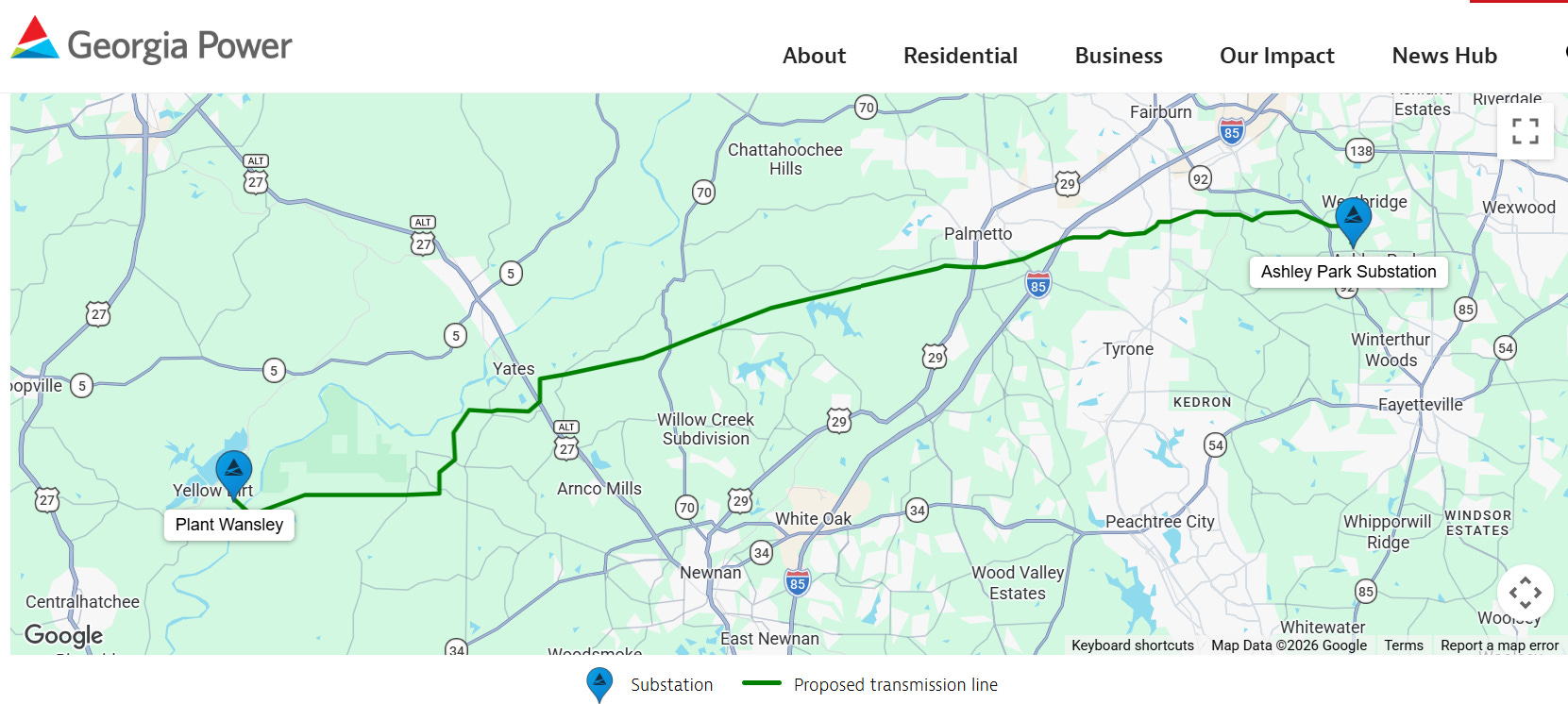
The two projects that have aligned EV-driving environmentalists and diesel pickup driving conservatives include a sprawling new data center development in Coweta County northwest of Newnan, and a 35-mile-long high voltage transmission line. The new high kilovolt (kV) transmission line will connect to former coal-fired power plants that Georgia Power is repowering with natural gas, both of which will feed electricity to the new data center near Newnan and one already under construction ~30 miles northeast near Fayetteville (in Fayette County). The data center project in Fayette County operates under the (Trojan Horse) moniker “QTS Technical” (QTS) to divert attention from its actual Big Tech customers.
Georgia Power’s website shows the Ashley Park – Wansley 500 kilovolt (kV) Transmission Line Project running west from the new Ashley Park substation built to serve the QTS data center in Fayette County to two Georgia Power electricity generation plants - first to Plant Yates in Coweta County, then on to Plant Wansley in Heard County. Georgia Power describes the project as (emphasis added):
“..a key component of our Integrated Resource Plan (IRP) and supports the continued growth of the state’s energy needs.”
Project Sail is the recently approved data center project northwest of Newnan. As is commonly the case with large scale, high-profile projects, a local developer assembled the land and used his connections to work through the zoning and county approval process. Atlas Development, LLC is working in conjunction with pedigreed, publicly traded industrial developer and REIT, Prologis, who will build the project Atlas itself couldn’t.
Neither Atlas nor Prologis will name their future tenant(s). Using a local developer to run cover for those who’d like their names to be kept out of the public eye is a common tactic when Big Tech wants to go into a rural community.
At Project Sail, Prologis plans to build a data center campus with 9 buildings on ~830 acres, with a total of ~4.3 million square feet under roof. Seven of the data center buildings would be designed to pull 72 megawatts (MW) each, with the remaining two each pulling 48 MW, for total electricity demand of ~600 MW. Atlas’ Development of Regional Impact (DRI) application lists a 10-year build out with a total value of $17 billion, generating $163 million per year in estimated annual local tax revenues. Its independent financial analysis suggests $434.1 million in net revenue to Coweta County, and net revenue to the school system $876.3 million, over twenty-one years.
Opponents of the project call bullshit on those figures. But we can see how such eyewatering figures could cause locals who love high school football and see some of the insane high school stadium projects the oil industry built in Texas to start dreaming big. And Georgians sure love their high school football.

Our overlay below shows the Project Sail layout northwest of Newnan near the small community of Sargent. The facility just out of view immediately to the north is Georgia Power’s Plant Yates.
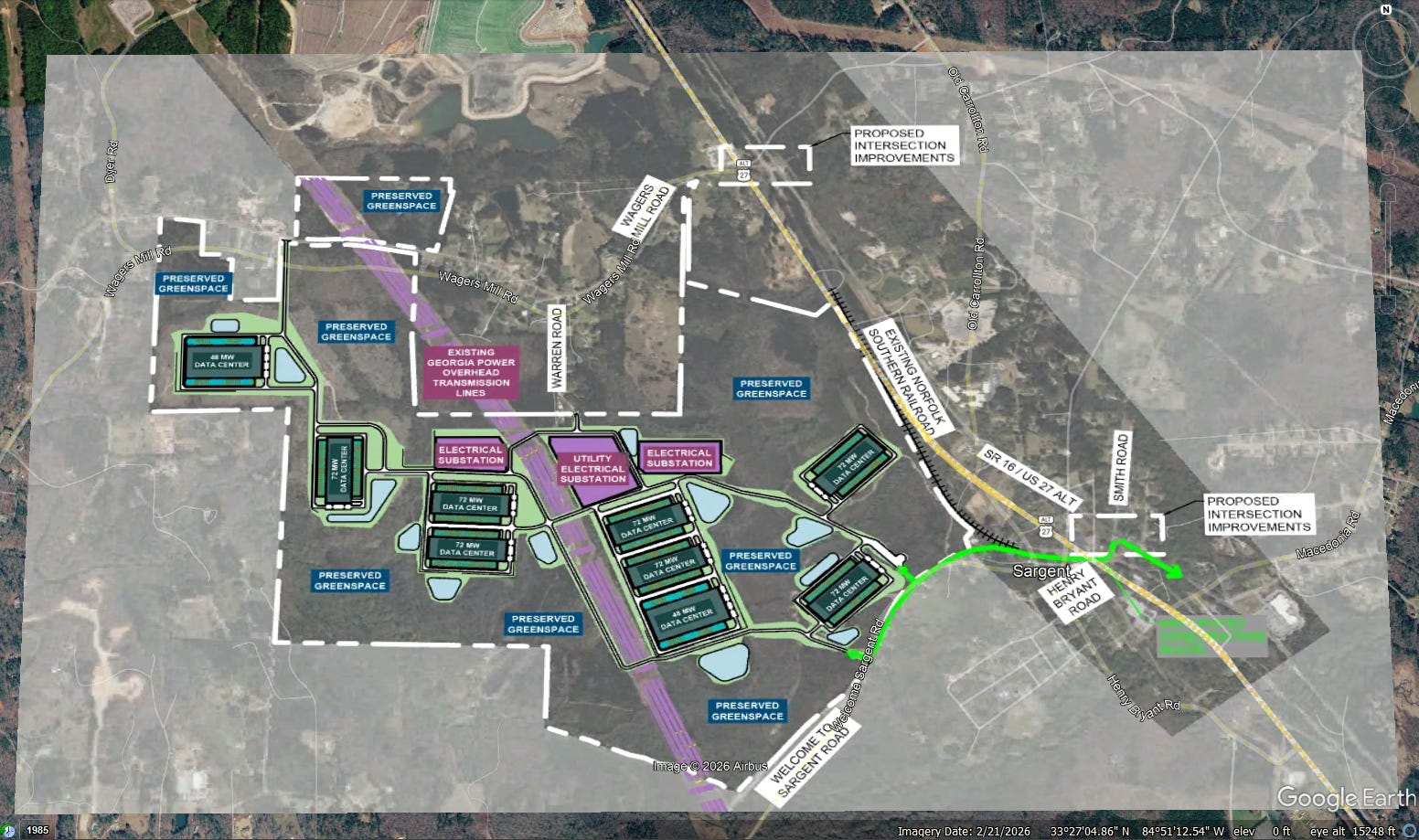
Historically, Plant Yates had 7 coal-fired steam units generating ~1,250 MW. In 2014, five of those were closed and the remaining two converted to natural gas, each with 403 MW nameplate capacity. In April 2024, Georgia Power received approval to add three natural gas turbines at the site, with nameplate capacity totaling ~1,300 MW. Once fully completed, Plant Yates’ generation capacity will be a bit over 2,100 MW.
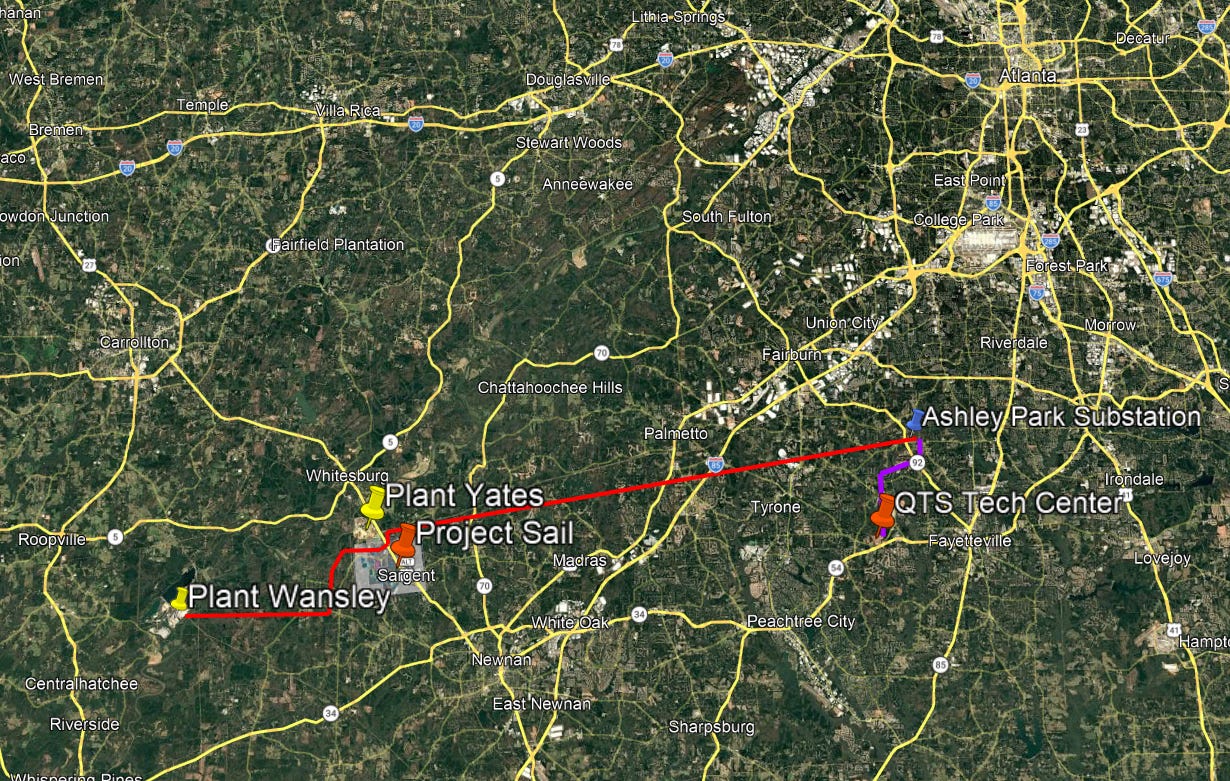
At the western end of the Ashley Park – Wansley High kV Transmission line, Georgia Power is also in the process of repowering decommissioned coal-fired power units at Plant Wansley with two 750 MW combined cycle natural gas units and 500 MW of battery energy storage systems (BESS) at Plant Wansley. The satellite image below shows Project Sail, the Ashley Park – Wansley transmission line (red), and the two Georgia Power plants in relation to Newnan, Fayetteville, and south metro Atlanta.
In a rural area where 800 acres of land is assembled for a large project owner (or tenant) who would rather go unnamed, there is usually some home cooking going on having to do with land sales and the assemblage, good old boy networks involving the members of the zoning board, and lobbyists. The local developer is the bagman and usually runs those gauntlets for the big out of town monied players, using his local connections and getting a healthy vig in the process. All these allegations surround Project Sail, and locals noticed the smell early in the process.
Georgia Power’s claims that the Ashley Park – Wansley Transmission line project supports load growth generally, rather than the two data center projects specifically, has a similar rotten odor. Opponents of Project Sail have alleged that the utility began negotiating behind the scenes with Atlas and Prologis while preparing its most recent Integrated Resource Plan (IRP) the Georgia Public Service Commission (PSC) approved in July 2025. That IRP began as follows (emphasis added):
“Georgia continues to be the number one state in the country in which to do business and we are in the midst of an extraordinary period of economic growth. We continue to see positive short and long-term economic development trends, with many of the businesses coming to the state bringing large electrical demands. Over the next six years, we project approximately 8,500 megawatts (MW) of electrical load growth — an increase of approximately 2,600 MW in peak demand by the end of 2030 when compared to projections in the 2023 IRP Update.”
QTS’ Fayetteville “giga campus” with 13 buildings and roughly 6.2 million square feet is being marketed as a multi‑phase campus with ultimate capacity ~1.4 gigawatts (1,400 MW), with an initial power draw ~250MW. Project Sail plans power demand of 600MW in the initial ten-year buildout, but an August 2025 letter from Georgia Power to Prologis notes (emphasis ours):
“You have indicated that the electrical load at the Premises will, over time, reach approximately 910 MW (the “Projected Load”).”
And the Financial Impact Analysis Atlas and Prologis provided to the County for Project Sail describes “a nine-building, 972MW facility.”
At full buildout, the two projects combined have the potential to draw more power (~2.3GW) than the total output of the first two new commercial nuclear reactors built in America in 40 years, which happen to be Georgia Power’s Plant Vogtle Units 3 & 4 (~2.2 GW or 2,200 MW). It is not pure coincidence and ordinary industrial or economic growth that caused Georgia Power to suddenly find 2,600 MW of new load demand over the next six years between its 2023 and 2025 IRP updates.
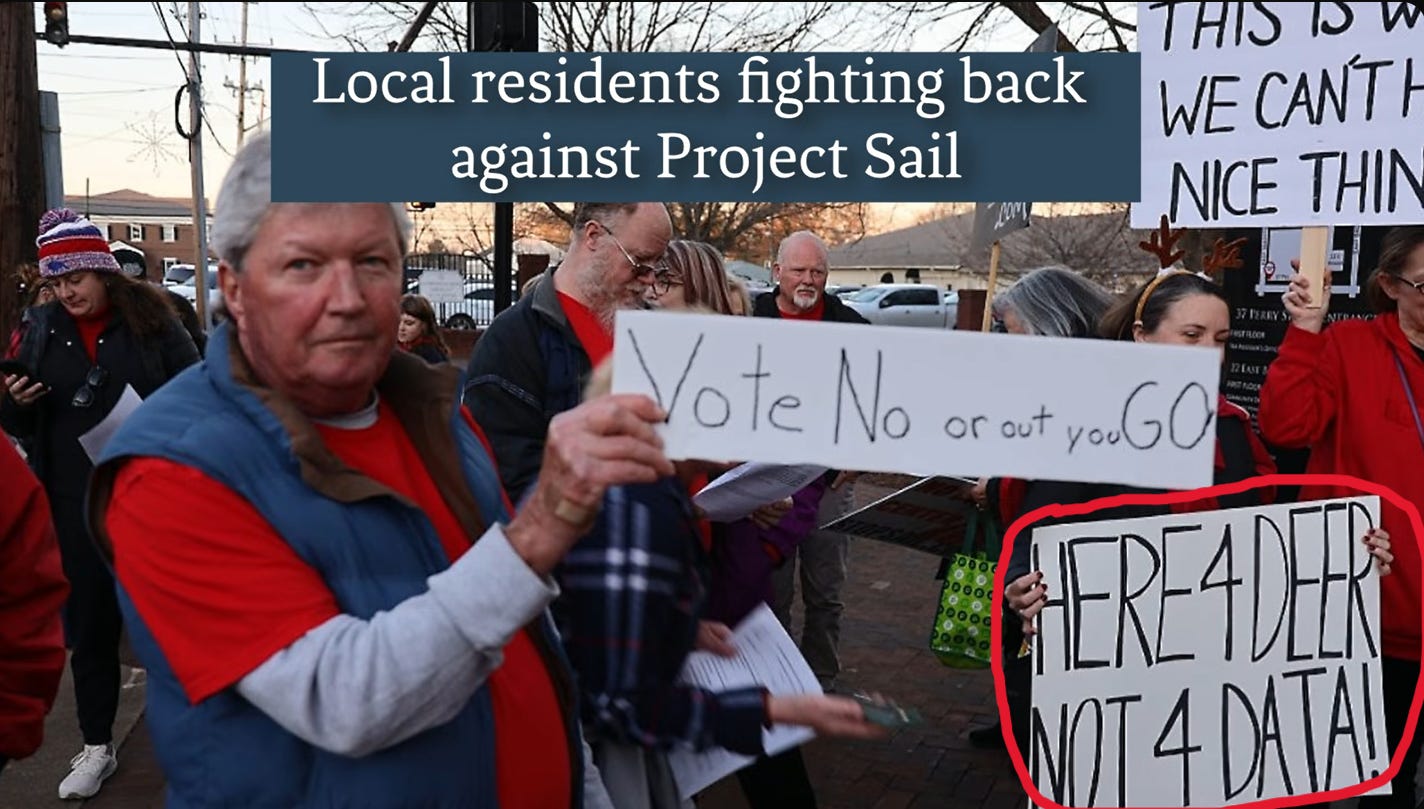
Local opposition to Project Sail includes well-founded concerns over destroying the rural character of Coweta County, water use (the DRI states 9.1 million gallons/day) and impacts to Wahoo Creek and wetlands in part of a watershed designated as a “Most Significant Groundwater Recharge Area” in the Middle Chattahoochee River basin by the Georgia Department of Natural Resources. Those issues cut across both sides of the political spectrum.
Atlas Development initially undertook to rezone the project site from rural conservation to light industrial use in December 2024. Shortly thereafter Citizens for Rural Coweta evolved as the main community/advocacy group organizing opposition, petitions, public comments, legal actions (including appeals and lawsuits), scientific analyses of impacts, and public meetings. It added a Political Action Committee last summer.
Around the same time as Citizens for Rural Coweta County was formed, the Facebook group “Stop Project Sail Newnan Data Center” emerged. That group is now simply Stop Project Sail and has an entire website dedicated to the effort.
Coweta County adopted a new Data Center Ordinance in December 2025, and in January of this year Atlas Development amended its rezoning application from “light industrial” to “industrial.” The latter classification allows the most intensive industrial use and the broadest range of industrial operations under the county’s code. That’s when opposition to the project went into high gear.
Opposition to Project Sail really hit hyperdrive on April 7 when the Coweta County Board of Commissioners voted 3-2 to approve Atlas’ revised zoning application. On May 5th, seventeen residents filed an appeal in Coweta County Superior Court challenging the County’s approval of Project Sail, naming both Coweta County and Atlas Development, LLC as defendants.
Among other allegations, the residents allege the property falls within an area designated in Coweta County’s Comprehensive Plan for “Rural Places and Complete Communities,” not industrial development, and that the County improperly rezoned the land. They filed the action as a Petition for Review/Appeal and Request for Declaratory Judgment under Georgia’s zoning procedures law. The appeal asks the Superior Court to declare the rezoning invalid and prohibit construction and operation of the proposed hyperscale data center campus on the property.
Opponents also quickly coalesced around the threat of eminent domain for the Ashley Park – Wansley High kV Transmission line that impacts Coweta County residents where the two projects intersect. The line is anticipated to impact more than 330 properties in Coweta and Fayette counties. 20–30 homeowners are faced with complete demolition to clear the right‑of‑way that Georgia Power will use to feed the QTS facility in Fayetteville and Project Sail. Georgia Power frames this as nothing more than its 10‑year transmission plan to meet rising electricity demand from data centers, industry, and growth in south metro Atlanta.
In Part 2 we look at the makeup of the opposition and the bigger problem emerging for Big Tech and data centers.
“Like” this post or we’ll build a giant data center or transmission lines to feed it that might require your property.
Leave us a comment. We read every one and respond to nearly all. Refuels the tank here.
environMENTAL is a reader-supported publication. Subscriptions are free but please consider becoming a paid subscriber below.
Share this post. Helps us grow. We’re grateful for the assist.
One thing I have noticed is a similarity in the behavior of Big Tech and Big Oil when defending their own development. They are too often silent about what actually creates the need for their products. Figures I have seen say only 15% of usage of datacenters is for AI, yet the opponents use AI as the boogeyman. Perhaps if Big Tech pointed out that all those phones ya'll carry around and never stop looking at are actually what is creating the need for datacenters (20-40% of usage), and also point out that all those streaming services that are replacing broadcast and cable television are another huge chunk, with the rest being used by industry for cloud services, people might realize they themselves have created this dragon that they seek to kill.
Thanks for the writeup, very interesting. There is no obvious correct answer, only a question of the tradeoffs that will be acceptable to both sides. I imagine this winds up at USSC