

Decades in Days
One month into the war in Iran, the world sits at a dangerous, second inflection point.

“There are decades where nothing happens; and there are weeks where decades happen.” -(attributed to Vladimir Lenin)
A few events that have occurred since the turn of the century seem in retrospect to have been weeks when decades happened by virtue of how profoundly the consequences of each changed the world.
September 11, 2001.
The Great Financial Crisis in September of 2008.
Covid-19(84) in the spring of 2020.
Terrorism. Fraud. A virus created in a lab. All of these events caused significant economic damage.
In each case, the global economy recovered, even if growth came at a slower pace and the consequences of piling printed money on growing government debts and deficits have yet to be fully realized. But the global supply of energy was not the cause of any of these historic, world-changing events.
A month into the war in Iran, Israel and the U.S. have killed scores of Iran’s theocratic political leaders and those of its Islamic Revolutionary Guard Corps (IRGC), exacted a heavy toll on the country’s military assets, and damaged or destroyed a significant portion of its missile and drone stockpiles, production and launching capabilities. But despite these facts, Iran continues to strike Israel and its U.S. allied Gulf neighbors with nightly attacks of both.
In addition, by virtue of the fear of those missiles and drones, and despite reportedly having most of its naval assets damaged or destroyed, Iran continues to exert de facto control over the vital Strait of Hormuz, through which 20 million barrels of crude oil and refined products - 25% of the world’s seaborne crude - and 20% of the world’s liquefied natural gas (LNG) ordinarily pass daily. That they have done so without a navy, from land, is a testimony to how much warfare has changed since the U.S. last engaged in a major conflict in the Middle East.
Iran has declared that U.S. energy companies’ fractional ownership interests in its neighbors’ energy production assets makes them legitimate targets in retaliation for attacks on Iranian energy infrastructure. And in the overnight hours of March 18/19, its retaliation against the Qatari LNG facility we noted in our last post was, in our view, the first inflection point in this war, and a clear signal about how Iran intends to prosecute it.
After we wrote Not Laffan Now, we watched the war evolve fearing escalations that would target oil and gas production facilities more widely across the Persian Gulf, and spread to civilian electricity and water production and distribution plants. When QatarEnergy’s Ras Laffan LNG plant was struck by Iranian ballistic missiles, we viewed the event as a significant step up the escalatory ladder.
Why was the attack at Ras Laffan such an important first inflection point in the war in Iran? What is the next inflection point that would cause the global energy crisis, and the human toll, to go from bad to much worse? And regardless of the final outcome, how might global hydrocarbon energy flows, and the energy, environmental and economic policies of the West’s advanced industrial nations, all change in the wake of the war in Iran? Let’s review the big picture since the attack that damaged Ras Laffan, consider the risks in play, and speculate whether an energy crisis far worse than 2022 might shake advanced nations like Europe and Great Britain out of their climate-induced stupor.
Before we begin in Qatar, our story requires a brief detour to recount an event which occurred in Israel on October 1, 2024. That day, Iran launched a missile barrage into Israel in retaliation for the latter’s assassination of Hamas leader Ismail Haniyeh in Iran, and strikes that had killed a senior IRGC leader and Hezbollah Secretary General Hassan Nasrallah in the prior sixty days. This event would turn out to be highly relevant to the current war in Iran.
As reported by Israeli media, of the approximately 200 ballistic missiles Iran launched in Operation True Promise II (emphasis added):
“Approximately 20 of them were intercepted or thwarted before entering Israel’s airspace by the United States, British and Jordanian air forces, leaving around 180 missiles that were either intercepted or impacted within Israeli territory.”
Around 30 ballistic missiles struck on and around the Nevatim Airbase in southern Israel, with one causing significant damage (that was clearly visible in satellite images) to an aircraft hangar. Two missiles were reported to have struck near Mossad headquarters outside Tel Aviv, with three others potentially hitting structures on the Tel Nof Airbase near the city of Rehovot.
Why did this event matter? To our knowledge, it was the first time that Iran demonstrated that it could launch a series of ballistic missiles that could overwhelm Israel’s highly sophisticated missile defense system and hit targets with some degree of precision.
As we noted in Not Laffan Now, Iran hit QatarEnergy’s Ras Laffan LNG liquefaction plant with a minor drone strike within 48 hours of the start of the war in Iran. The social preview for that piece warned:
“One serious attack on a single Middle East LNG export facility and the EU’s self-inflicted energy crisis gets even worse.”
We conclude that March 2nd drone strike was Iran’s way of showing that it could hit the facility.
When Israel attacked (with or without U.S. help) the South Pars natural gas field that Iran shares with Qatar in the Persian Gulf on March 18th, Iran’s retaliation was swift. Within hours of declaring Ras Laffan as a target in retaliation, Iran hit two of the site’s 14 LNG trains with ballistic missiles, damaging $20 billion worth of energy infrastructure and putting ~17% of its production offline for 3-5 years. Almost 4% of marketable global LNG production was taken down in a matter of moments.
In our view, the precision with which the attack was conducted constituted the war’s first major inflection point. Why?
QatarEnergy holds the majority interest in all 14 LNG trains at Ras Laffan. Train 4 is a joint venture between QatarEnergy (66%) and ExxonMobil (34%), and Train 6 is a joint venture with QatarEnergy owning 70% and ExxonMobil 30%. According to QatarEnergy CEO Saad al-Kaabi, the damage to these trains impacts supplies to Italy, Belgium, Korean and China.
According to our research, American energy firms hold significant stakes in ten of Ras Laffan’s 14 LNG trains, meaning eight other trains co-owned with QatarEnergy have not be hit. In addition to ExxonMobil (which has ownership interest in 9 of the Ras Laffan LNG trains), ConocoPhillips has interest in one of those trains.
Ras Laffan was not the only QatarEnergy facility hit at the giant complex that week. The Pearl GTL (gas-to-liquids) plant - a multibillion-dollar facility that converts natural gas into fuels, and oils used to make premium lubricants, paraffins, and waxes - was also attacked the day prior, sustaining damage to one of the plant’s two trains. The joint venture between QatarEnergy and Shell is the world’s largest GTL plant and, as Shell proudly notes, “one of the world’s largest, most complex and challenging energy projects ever commissioned.” The fifteen-year-old plant had a price tag of about $20 billion.
As a representative for Saad al-Kaabi, noted the day after the strikes:
“The damage caused to one of the two trains at Pearl GTL is being assessed and is expected to be offline for a minimum of one year .. and … would also lead to the loss of the following products and amounts:
· Condensates: 18.6 million barrels which is around 24% of Qatar’s exports
· Liquefied Petroleum Gas: 1.281 MT which is around 13% of Qatar’s exports
· Naphtha: 0.594 MT which is around 6% of Qatar’s exports
· Sulfur: 0.18 MT which is around 6% of Qatar’s exports
· Helium: 309.54 MCFA which is around 14% of Qatar’s exports
The very next day, speaking of the damage to the two LNG trains he said the damage to the facilities that had cost $26 billion to build would impact LNG deliveries to Europe and Asia for up to five years.
“The cold boxes are gone. This is the main unit, that is the cooling box of the LNG, it is completely destroyed.”
At that point, any pronouncements from legacy media about the portion of Iran’s drone and missile launching capabilities that have been destroyed no longer mattered. The fact that Iran was able to use precision targeted ballistic missiles to hit $50+ billion worth of energy facilities (Ras Laffan’s two LNG trains plus Pearl GTL) partly owned by Western energy majors while avoiding the rest was the war’s first major inflection point in our view. If Iran could hit these facilities, it would be unwise to assume they could not hit refineries, production facilities, and other high value targets, including ships in the Strait of Hormuz closer than all of the above.
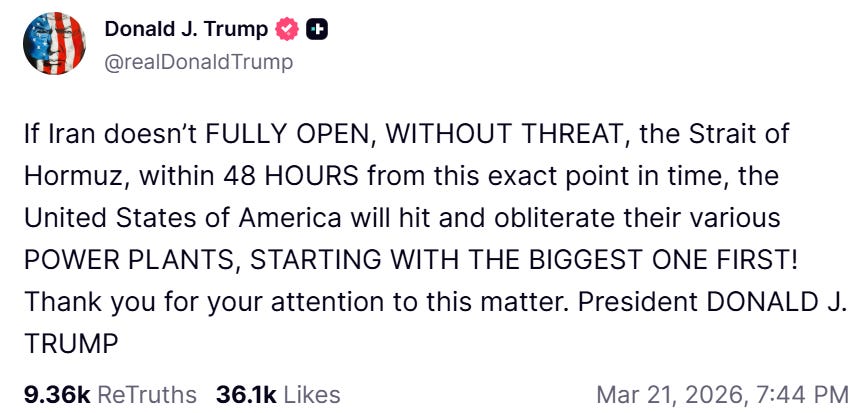
Two days later President Trump reacted to the strikes on Ras Laffan, several of Iran’s Gulf neighbor’s energy assets, and continuing strikes on Israel by giving Iran an ultimatum. At the time, it was not obvious to us that he had fully grasped the implications of what Iran demonstrated with the hits at Ras Laffan.
Making things even more complicated and dangerous, after Iran’s earlier noted October 1, 2024 missile barrage on Israel, Doomberg presciently foresaw the present danger in more humanitarian terms. More than ten million residents’ ability to live in the Middle East’s only democracy depends on the continued operation of no more than ten power generation and water desalination plants that provide 75-80% of electricity and fresh water. All of these facilities are concentrated in an area about the size of New Jersey and are easily identifiable (emphasis ours):
“Consider Israel’s electricity grid. Five large thermal power plants account for approximately three-quarters of the country’s power output, with the balance coming primarily from intermittent solar, wind, and a few smaller natural gas plants. The country has been systematically shifting away from coal and toward natural gas, in large part because it is now a net exporter of the latter. Israel produces much of its gas from offshore reserves in the Mediterranean Sea, particularly from two large fields, Leviathan and Tamar.
Layered upon this concentrated risk is the fact that nearly 80% of Israel’s drinking water is sourced predominantly from just five large desalination facilities. These operations require copious amounts of electricity to run and are essential to everyday life in the country. Were they to be taken offline, a significant humanitarian crisis would swiftly follow.
The precise geolocations of these dozen targets—above ground and difficult to harden against external attack—are widely known to all involved. If Israel’s air defense systems are no longer capable of stopping a large barrage of missiles, a significant and directed attack against the country’s energy and water treatment facilities would be catastrophic. The potential for this knockout blow radically changes the game theory involved in the decision to escalate.”
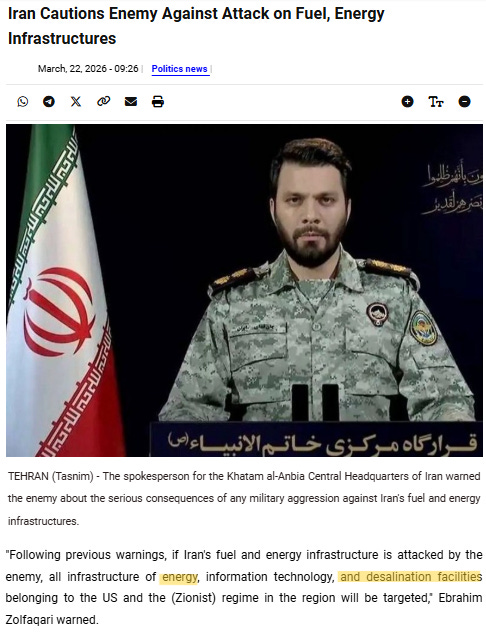
After Trump’s 48-hour ultimatum on Saturday evening March 21, a man whose face has regularly appeared over the last few weeks issued Iran’s response via Tasnim News Agency, the Iranian propaganda outlet of the IRGC. The specific targets he listed cemented our view of the war’s second major fulcrum.
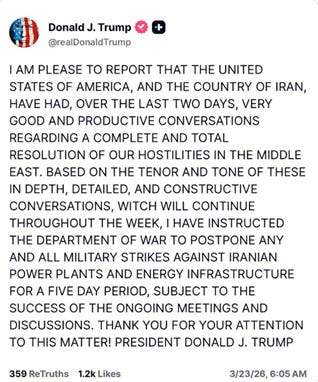
By Monday morning, Trump appeared to consider the implications of Iran’s ability to hit Gulf energy assets more broadly. With just over twelve hours remaining, he extended his first ultimatum deadline by five days.
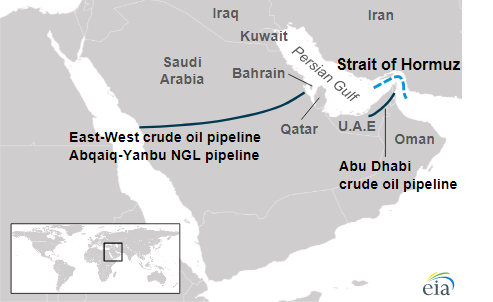
All 32 member countries have released (or agreed to release) crude from their strategic petroleum reserves in accordance with the International Energy Agency (IEA) plea (and earlier U.S. “recommendation”), with the U.S. authorizing the release of 172 million barrels. Saudi Arabia has maxed out their East/West pipeline to get some crude locked in the Strait of Hormuz out via the Red Sea, and the UAE is using the Habshan–Fujairah (aka Abu Dhabi) oil pipeline to get crude beyond the Strait directly to the Gulf of Oman, but Iranian drones have attacked caused fires at its terminal at Fujairah at least twice in March.
Incredibly, the U.S. eased sanctions Iranian oil trapped at sea to increase flow and calm markets while it was shelling Iran. It also eased sanctions on Russian oil for the same purpose. Meanwhile, Iran has let some crude cargoes pass through the Strait of Hormuz, either for a ransom “fee” or for countries it did not deem aggressors or those collaborating with them.
But because of the threats that Iran demonstrated with the attacks on Ras Laffan and Pearl GTL, and more than two dozen additional strikes to other Gulf energy assets since, Iran remains in de facto control of the Strait of Hormuz at this writing. There is no way of putting a positive shine on this reality.
By the third week of the war, the IEA said that forty energy assets in the Middle East had been severely damaged. IEA Director Fatih Birol declared that the fallout from the conflict “is equivalent to the two major oil crises of the 1970s and the 2022 gas crisis put together”.
We asked Perplexity AI to prepare a map of the oil production, refining and terminal facilities, as well as the LNG liquefaction and export facilities, which have been struck by Iranian drones or missiles since the war began. It identified 30 strike events at 18 facilities in six different Persian Gulf neighbors:
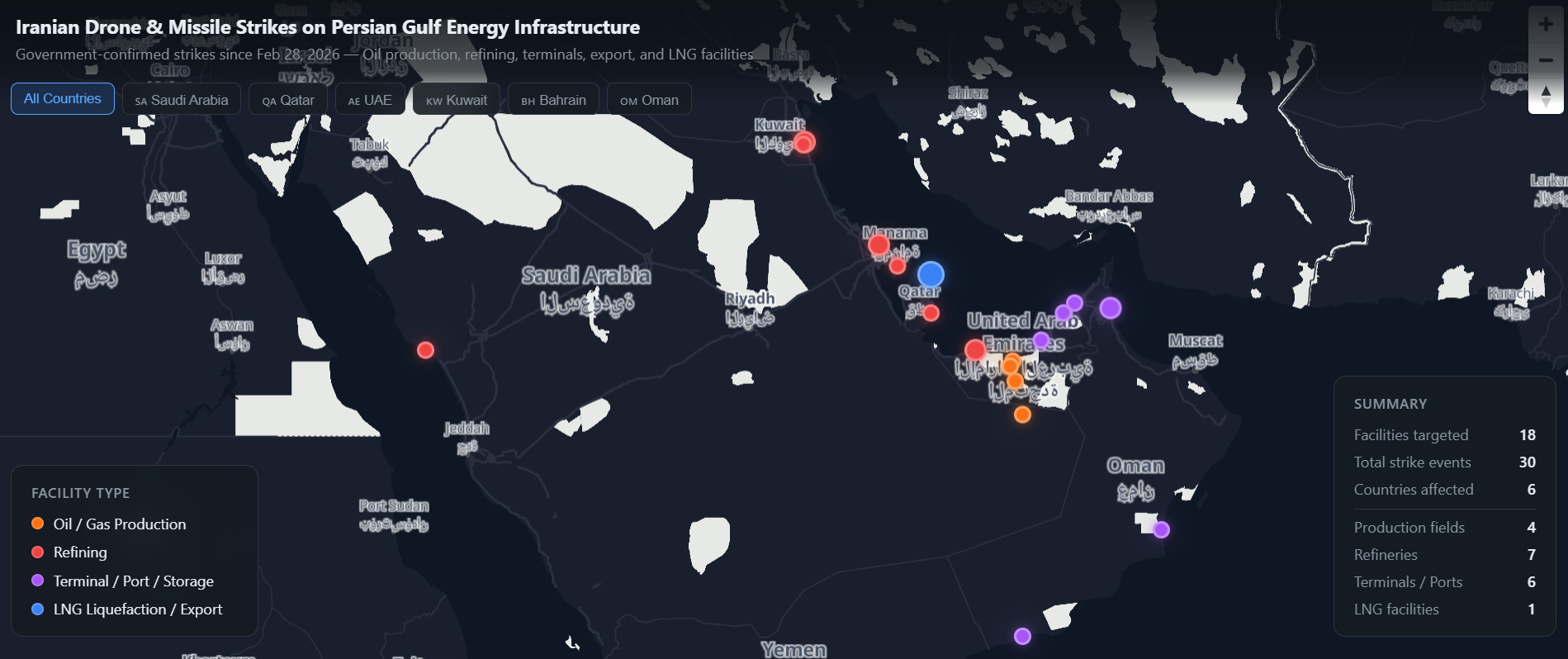
By our rough calculations, even with the Saudi, UAE and other workarounds, the global oil market is still short about 10 million barrels per day (mmbpd) of crude oil versus pre-war trade, and there is no workaround for the 20% of global LNG production presently trapped on the wrong side of the Strait of Hormuz. 17% of that LNG production would not be available to the world at least 3 years if the war ended today. And QatarEnergy has postponed additional work on its enormous North Field expansions that would have brought billions more cubic feet of capacity per day online at Ras Laffan in the next two years.
Before Trump’s first deadline extension could expire on March 28th (a weekend, no doubt in relation to global oil and stock markets), he extended it again, attributing the move to a request by Iranian government authorities.
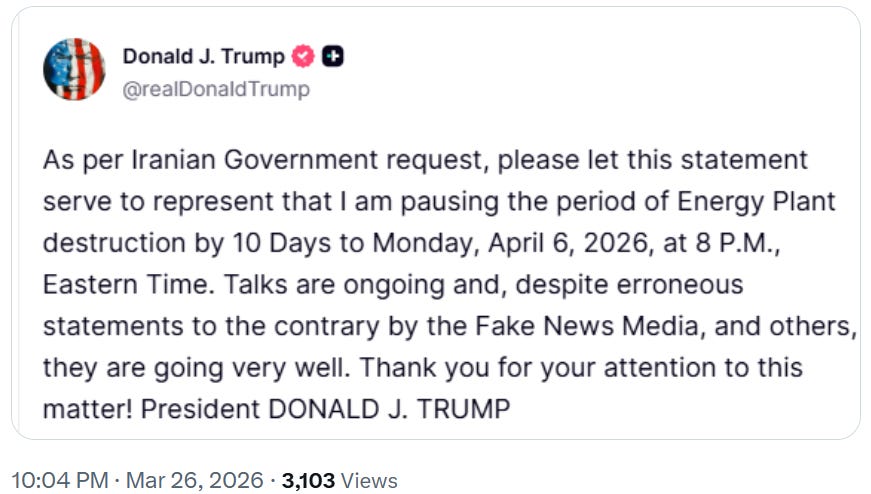
Regional and some western media sources reported that Iran did not request the extension. Israel and the U.S. continued to pound Iranian targets. Iran continued to mete out its ballistic missiles and drones to demonstrate that it still has the capability to hit strategic targets.
The two sides have allegedly exchanged their terms for ending the conflict. Iran has rejected the U.S. 15-point plan. The U.S. has rejected Iran’s 5 key conditions. This morning, China and Pakistan advanced a “Five Point Initiative for Restoring Peace and Stability” calling on the parties to “immediately stop attacks on civilian and non-military targets .. and stop attacking important infrastructure including energy, desalination and power facilities, and peaceful nuclear infrastructure, such as nuclear power plants.”
Control over the Strait of Hormuz is the key issue both parties’ demands. At the end of this conflict, one will not get it.
All of this has led to where we stand today. The Strait of Hormuz is effectively closed to around 10 million barrels per day of the world economy’s life blood. Nothing is passing through without Iran’s explicit permission. And thousands of U.S. Marines and hundreds (or more) of Special Forces are on their way to the Middle East or have already arrived in theater.
Widespread attacks on oil production, refining, and export facilities, more at Ras Laffan, and attacks on civilian electricity generation and water desalination plants are the next inflection point in the war. While we make no prediction as to the likelihood of that outcome, we have been considering the consequences of such an escalation. A new development that occurred over the weekend caused us to look more closely at the outcome we have feared since the war began.
On Saturday, Iran’s Houthi proxies fired missiles into Israel. By Monday it appeared they had joined the war. But several days previously, Iran began threatening to cut off shipping through the next major Middle East chokepoint. All maritime traffic back and forth between the Mediterranean Sea and the Arabian Sea has to pass through the Bab El-Mandeb Strait, a choke point narrower even than the Strait of Hormuz, between Yemen and the African coast at Djibouti.
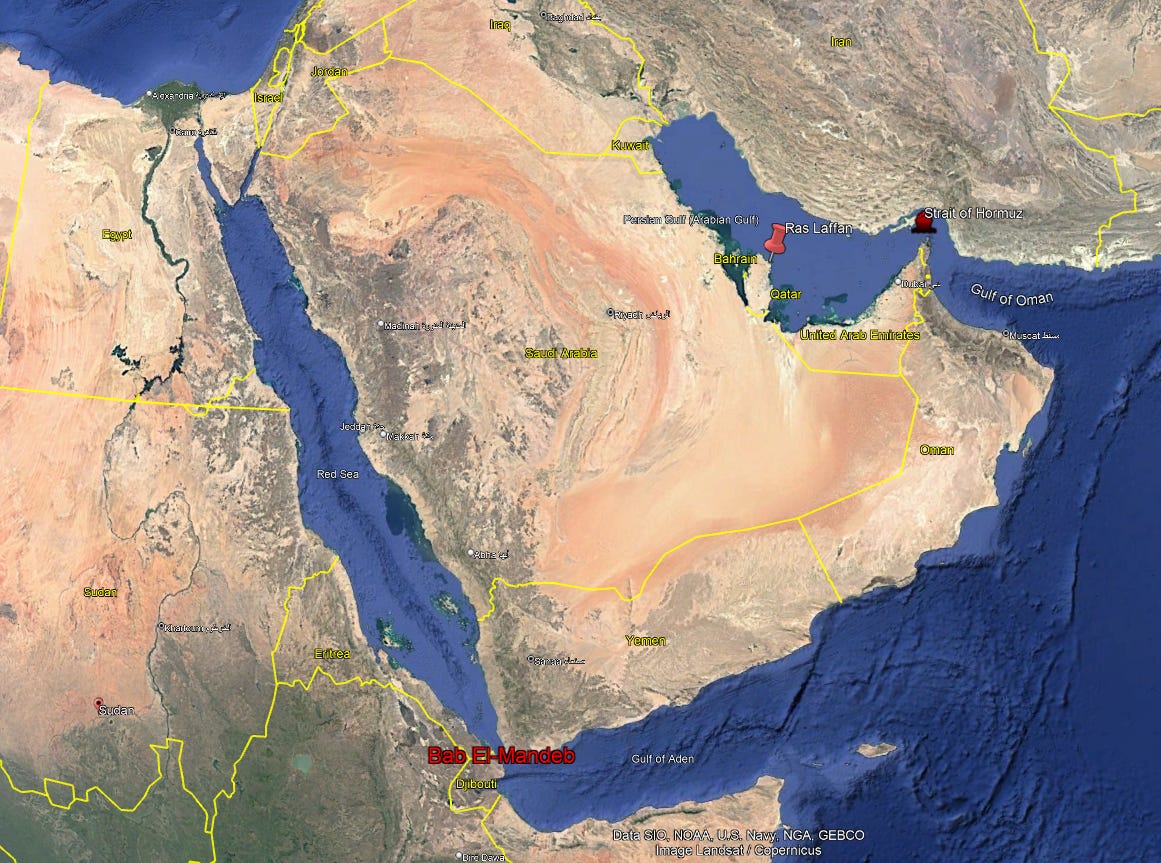
Starting in the fall of 2023, Houthi attacks threatened and rerouted significant volumes of global shipping traffic through Bab El-Mandeb. Prior to October 2023, ~9mmbpd of crude oil and refined products (~9% of global seaborne) and nearly 10 million cubic meters of LNG (about 8% of global LNG trade) transited the Strait each day. Since the attacks, LNG volumes have been practically reduced to zero, and crude oil shipments down to around 4-5mmbpd.
With the Houthi’s joining the conflict, the prospect of the world’s supply of vital oil and natural gas being threatened by the closing of two major Straits in the Middle East through which around 25% of seaborne trade of crude oil and refined products and over 20% of global LNG transited daily prior to the war in Iran is very much on the table.
And this is where things could quickly go from bad to much worse. Escalations from here likely mean increasing:
Attacks on oil production, refining, terminal, and export facilities across the region,
Attacks on Qatar’s Ras Laffan LNG megafacility,
Attacks on civilian electricity generating stations and water desalination plants.
Iran and the Houthis attempting to close the Bab El-Mandeb Strait.
A closure of the Bab El-Mandeb Strait would likely take another 2-3 mmbpd of global oil production out of the market, bringing the total global shortfall to ~15mmbpd. On top of 20% of world LNG supply being temporarily trapped behind the Strait of Hormuz (and 17% of that not coming back for two or more years even if the war ended tomorrow), the world’s markets and producers of oil and natural gas could not fully adjust in 2026 or 2027 under any circumstances.
Now imagine a situation in which widespread destruction of Middle East oil and natural gas production facilities takes place in a war that continues for two or three months, or more. Under those circumstances the potential for a loss of more than 15mmbpd of global crude oil production for a period of several years is a very real, even if remote, possibility.
And energy products are not the only key global commodities at stake in this scenario. We asked Perplexity AI to prepare tables showing pre-conflict volumes of key commodities passing through the Straits of Hormuz and the Bab El-Mandeb.
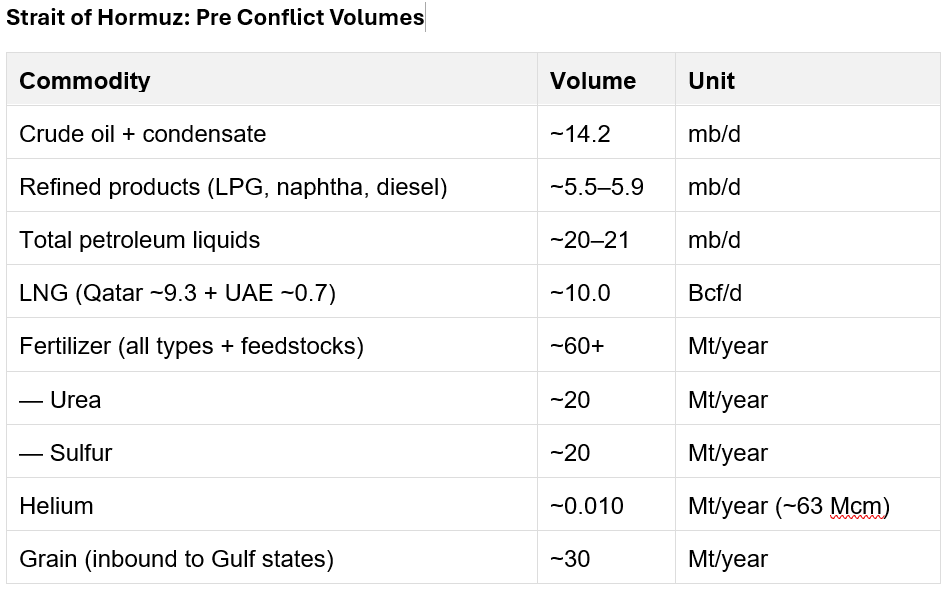
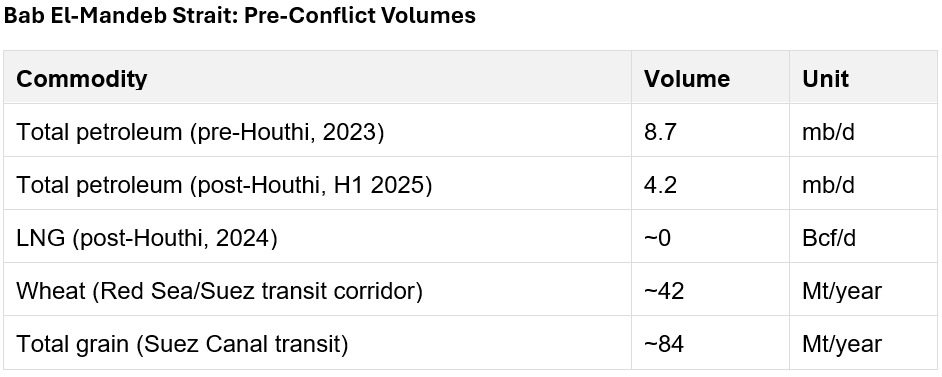
Assume half of all the crude oil and refined products, all of the LNG, and half of the other commodities above are displaced or rerouted at significant cost for another two months. Consider the possibility that 15mmbpd of crude oil are lost for 3-5 years. What would the global price of crude oil look like, and how would that impact western economies?
Imagine the cost of rerouting grain from European and Black Sea ports destined for the Middle East and Africa. How much less acreage might be planted in grains globally this spring due to the price of fertilizer or supplies being insufficient to meet global demand? What happens to food prices, and who suffers the quickest and the most?
And consider the lives of millions in the Middle East hanging in the balance if civilian electricity generation and desalination plants are attacked and disabled or destroyed in Israel, Iran, and Iran’s neighbors in the Persian Gulf. Those facilities cannot be rebuilt in a matter of weeks and days. What happens if tens of millions in the desert don’t have access to electricity, clean water, and sanitation for weeks or months?
As uncomfortable as these questions might be, we are forced to confront them as possibilities. The answers are beyond our expertise, and likely difficult even for those whose careers depend on them for the simple reason that the world has never been here before.
Finally, we believe that the future flows of hydrocarbon energy will look quite different when this conflict ends. Some significant, strategic reshuffling of global oil flows is highly likely.
We had Perplexity prepare a map showing global oil production and consumption by continent, separating the production and consumption into “East versus West” of the Suez Canal. The continents where the consumption bubbles in pink exceed the production bubbles in blue by a large margin are clearly in a bad position.
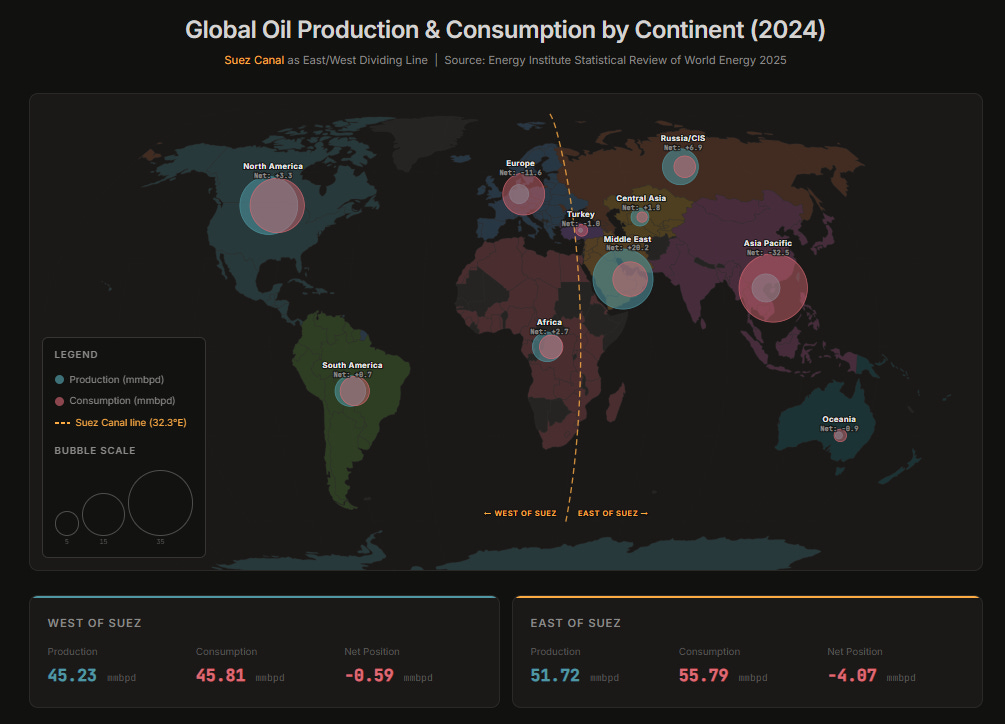
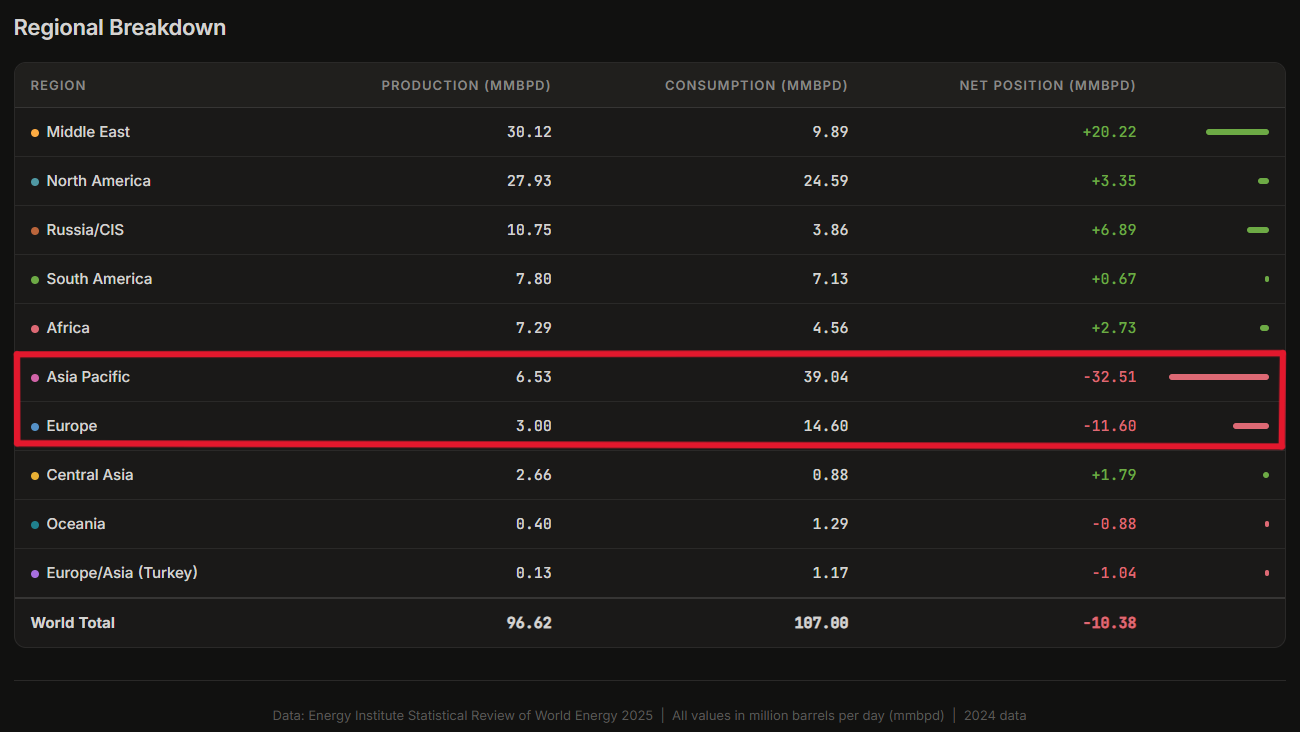
The West is better balanced between supply and demand than the East. The regional comparison shows how stark the problem is for Europe and Asia.. And just how different the picture is for the U.S. and Canada.
We ran the same exercise for the global LNG export/import trade. The results were similar. (Here, we told Perplexity to denote Turkey as a “continent” to separate its unique position as a country with feet in two continents, at the crossroads of Russian natural gas pipelines, and importing 100% of its gas consumption).
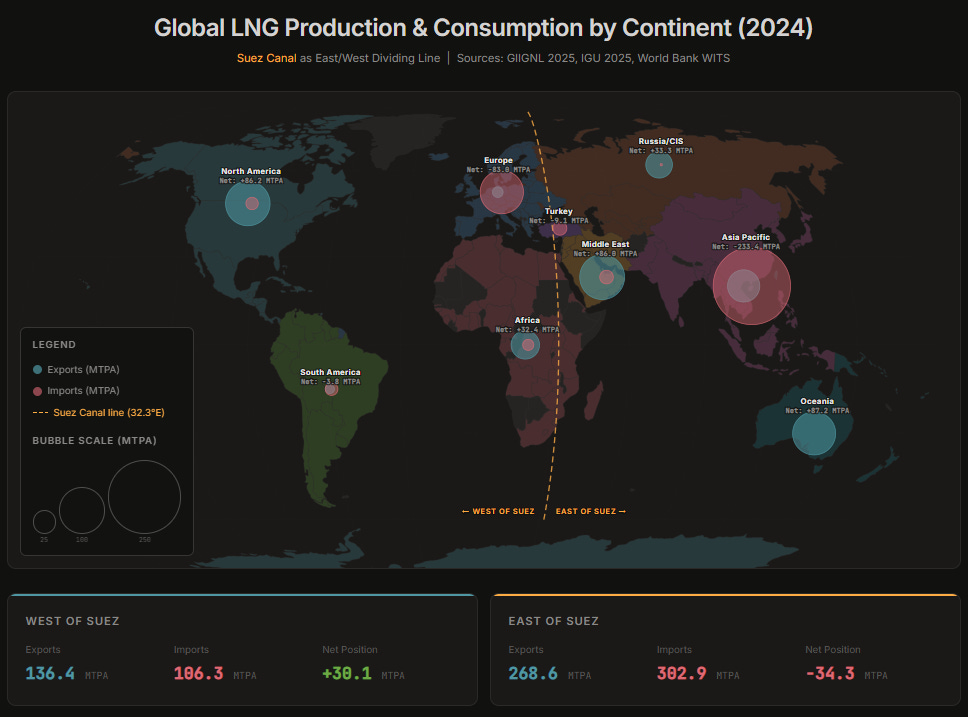
Here again, the regional comparison shows very clearly who is long and who is short LNG imports versus exports. The gap for “East of Suez” is even greater for natural gas than with crude oil.
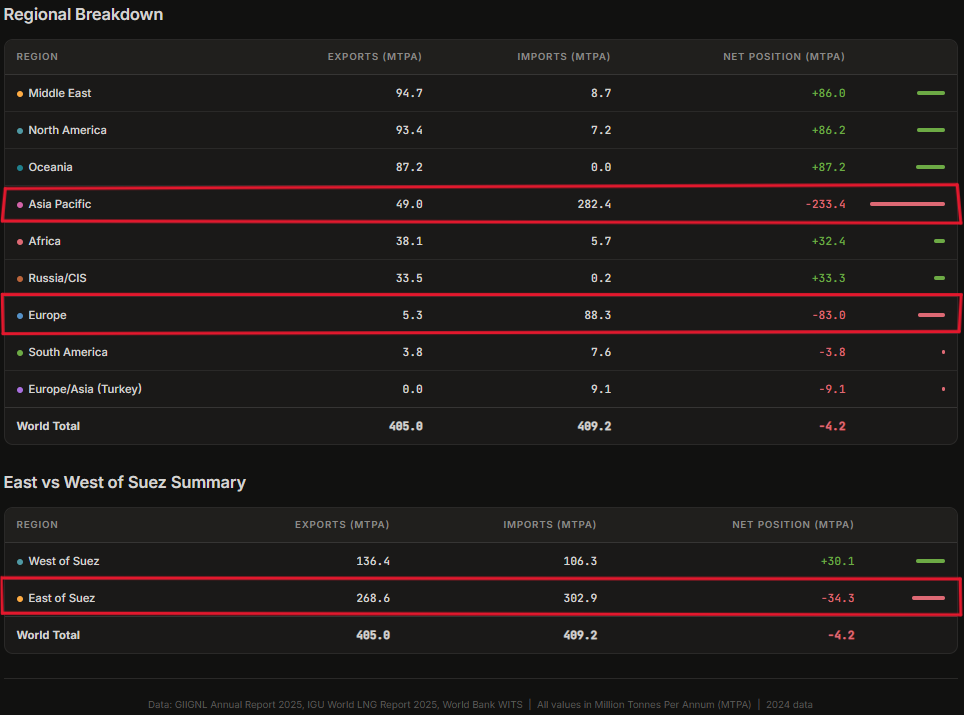
With the added emphasis on energy security and maritime disruption risk, it seems intuitive that more oil and natural gas production in the Middle East and Russia will likely be directed to, and consumed by, Asia than Europe and the west prior to this conflict. And more of North America’s energy abundance will be consumed by Europe (though with what passes for European “leadership” at present, anything is possible) with continued LNG support to Japan likely.
We conclude with three important observations. First, the shortages of oil and natural gas in the global supply chain created by this conflict will not be made up by production anywhere on earth in 2026. The world’s largest crude oil producers (the U.S., Saudi Arabia, and Russia) cannot deploy enough extra capacity, and the significant supply of LNG supply coming online later this year on either side of our East/West Suez divide will not arrive fast enough to alleviate the now baked-in shortalls.
Second, Iran cannot win this war militarily against the U.S. and Israel. But it does not have to. All it has to do is keep the Strait of Hormuz (and disrupt or close the Bab El-Mandeb Strait) long enough to impose more economic pain on the U.S. than Trump is willing to withstand. Iran has been locked out of the global economic system for long enough that its remaining leaders seem willing to suffer as much pain as necessary to inflict the necessary damage, assuming their ballistic missile and drone supplies hold up. And we are convinced that Iran is receiving precision target coordination and other help from Russia and China, who are all too happy to open a second front to the proxy war against the U.S. that has been playing out in Ukraine for over four years now.
Finally, we believe that the energy, environmental and economic policies of the advanced, western nations are being rewritten in real-time as a result of this conflict, regardless of the duration and outcome. This can already be seen in the actions of a number of Asian and even some European nations. Japan is going to burn more coal to make electricity and South Korea is extending the life of coal plants slated for closure. Even Germany has been forced to consider the climate taboo of restarting idled coal plants for power generation.
For Europe and Great Britain, a second energy crisis in four years should be the force that causes serious energy and environmental policy course correction. As Chris Keefer noted in a brilliant Decouple episode with Doomberg and written post recently, the French instituted the Messmer Plan and built 54 nuclear reactors in 20 years, and Britain and Norway opened up the North Sea after the Arab oil crisis in the 1970s. The usual suspects are suggesting this event will speed up adoption of “renewables.” We expect the opposite will occur, though we concede that Europe is going to try utility scale solar and batteries first before eventually conceding that these are not long-term solutions for energy security much less economic growth.
Events are moving quickly. This morning, Trump posted the below on Truth Social:
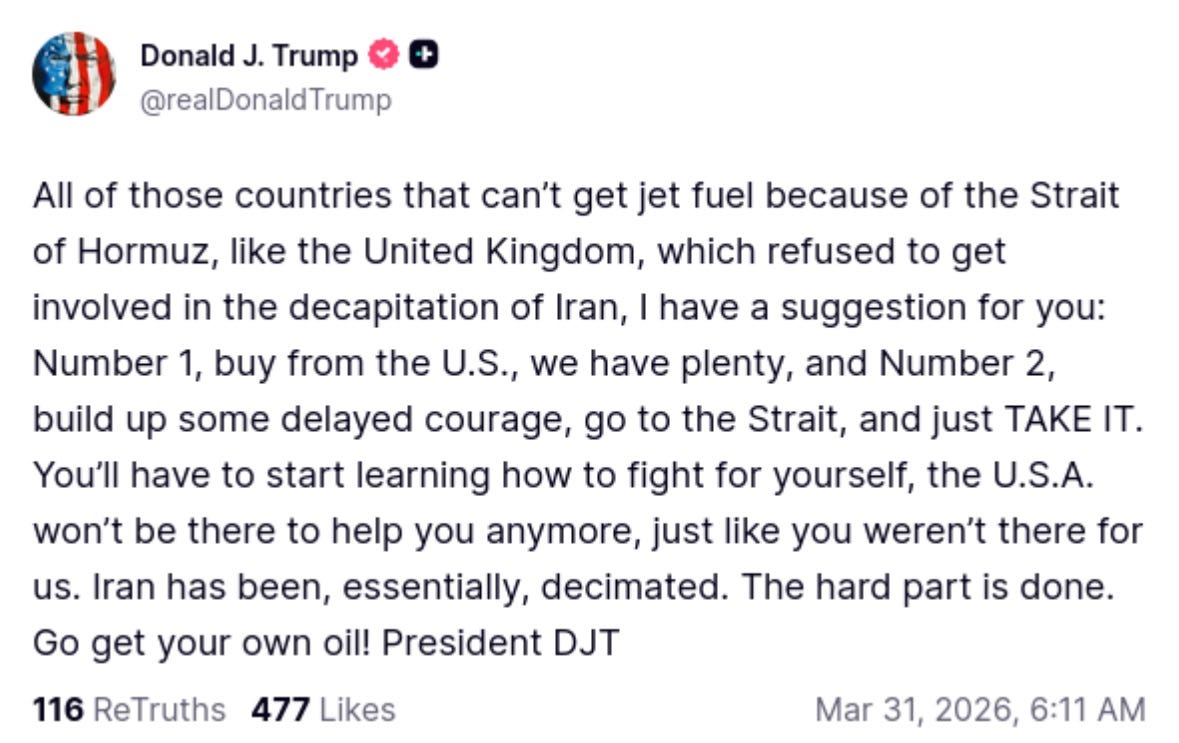
We stand at a dangerous crossroads. Decades in the future of energy geopolitics are likely to be decided in the days ahead.
The war in Iran is an historic world event that should finally dispel any notion that energy is a derivative of economies rather than the converse. We hope the escalations we fear do not come to fruition.
“Like” this post or we’ll register you for the draft … in Germany.
Leave us a comment. We read and reply to all. Refuels the tank here.
environMENTAL is a reader-supported publication. Please consider a paid subscription. Subscribe below.
Share this post. Helps us grow. We appreciate the assist!
This is what happens when you postpone dealing with a difficult problem for too long. We strike now because there is basically no choice: Iran made it clear that it intended to build MULTIPLE nuclear weapons. This is every kind of horrible you may imagine. Does anyone doubt for a second that Iran will absolutely use its nukes if it gets them?
No peace is possible as long as hardline theocrats rule Iran. It is a measure of their true character that they choose to damage the entire world in retaliation.
Terrific post by the way. Energy is everything, yet most folks know very little about it. However that might be changing soon, depending on events.