

Climate Gate The Memo (Pt. 2)
The flack shows Gates is over the target. What about his motive and timing?

(In case you missed it, Part 1, link here, summarized Bill Gates recent blog post Three Tough Truths About Climate. In Part 2, we cover some reactions from well-known climate change advocates and give our perspective on Gates’ timing and motivation).
We find each of Bill Gates’ Three Truths to be non-controversial statements with which we are in agreement, even as we take issue with the details. For example, we seriously doubt that these will occur by 2036:
“…with the right investments and policies in place, over the next ten years we will have new affordable zero-carbon technologies ready to roll out at scale” and that “all countries will be able to construct buildings with low-carbon cement and steel. Almost all new cars will be electric.”
But we share Bill Gates’ techno-optimism and believe humanity will innovate long-term solutions to most environmental problems we create. A few examples he noted are promising:
Some new SMR designs will succeed at cost and scale, eventually.
Fervo’s geothermal innovations.
Geologic hydrogen reservoirs, something Doomberg highlighted in a recent post, could hold significant potential.
So, we received Gates’ Memo with cautious optimism and gratitude for his shifting priorities that put lifting people out of poverty ahead of reducing CO2 emissions. But the reception from the “climate change is an existential crisis” crowd was less than enthusiastic. Or warm.
Gates’ memo has the cabal of climate scientists, climate activists, activist climate scientists, and Charlaticians in what Robert Bryce referred to as a sphincter-puckered snit, with a few respectful and thoughtful outliers.
Berkeley Earth climate researcher Zeke Hausfather commented that Gates’ memo “needlessly sets up a conflict between laudable goals (mitigating emissions and alleviate poverty, disease, hunger), was “a bit too cavalier in his treatment of climate risk”, and “assumes that funding for climate and development is inherently zero sum.” But his critique was calm, detailed and reasoned.
Speaking of the sphincter puckered, the social preview climate activist and founder of 350.org Bill McKibben chose for his Substack post on the Gates memo read: “Maybe we don’t need billionaire opinions on everything.” His comments were less diplomatic than Hausfather’s:
“It was wrong of him to write it because if his high-priced pr team didn’t anticipate the reaction, they should be fired” … and … “Any conversation about Bill Gates and climate should begin by acknowledging that he’s been wrong about it over and over again.”
That’s rich coming from the man who has been wrong about biomass and “climate change” over and over again. McKibben observed that Gates’ memo (emphasis added):
“.. is actually directed at delegates to the global climate conference next month in Brazil, essentially telling them to back off the emissions reductions and concentrate on growing economies in the developing world because “health and prosperity are the best defense against climate change.”
Quite the astute observation, Bill! Given the condition of 350.org’s deteriorating finances, including the recent decision to suspend U.S. operations and scale back staff to a skeleton crew, we believe Mr. McKibben’s time might be better spent looking introspectively.
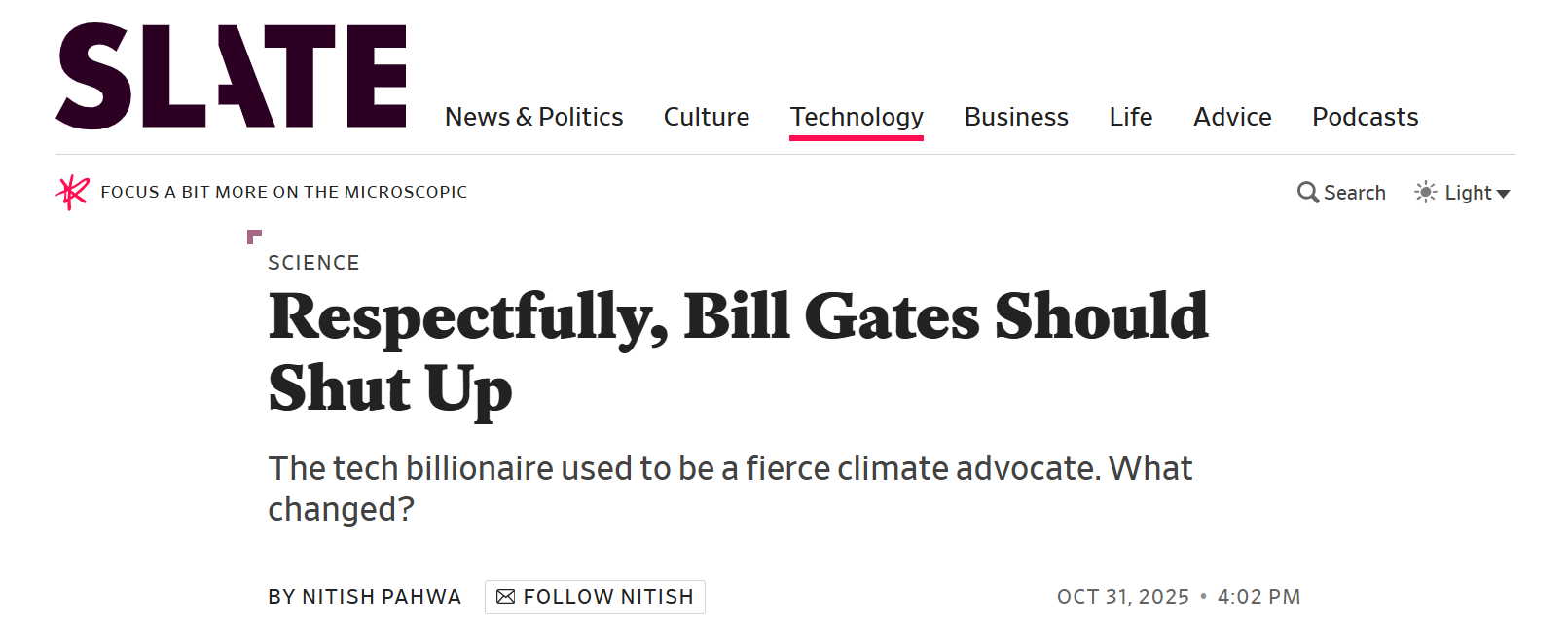
It went downhill rapidly from there. Slate represented well:
Three days after Gates published his Note, climate scientist/activist/frustrated litigant Dr. Michael Mann published a critical if not demeaning article on the website of the Bulletin of the Atomic Scientists (keepers of the Doomsday Clock!). Attempting to visually paint Gates in the worst possible light, the Bulletin’s editor used a picture of Gates with Trump’s first Energy Secretary.
Ironically, rather than demeaning Gates, the editor’s choice of photo gave perfect visual form for part of what motivated his memo. Perry is co-founder of Fermi America, a massive energy industrial park for Big Tech data centers and AI hyperscalers in Texas that went public last month. Located adjacent to Texas’ prolific Permian basin, Fermi is an unapologetic natural gas to nuclear energy play for Big Tech and AI.
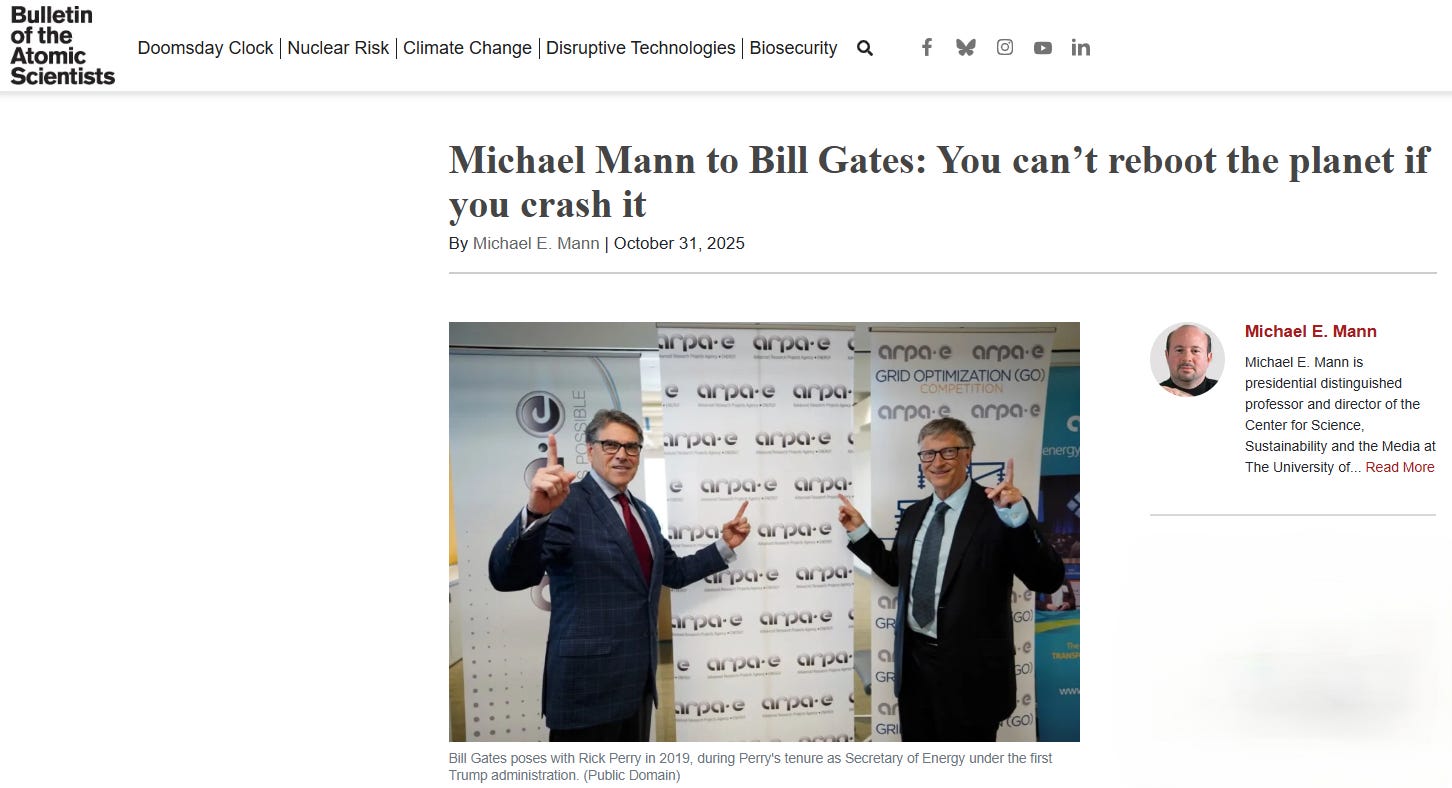
“What Gates is putting forward aren’t legitimate arguments that can be made in good faith. They are shopworn fossil fuel industry talking points. Being found parroting them is every bit as embarrassing as being caught—metaphorically speaking—with your pants down.”
Like McKibben’s, Mann’s comment was rich, only more so. The activist climate scientist and his legal team were actually caught with their pants down. In March a judge sanctioned them for acting in bad faith by presenting false claims about lost grant funding in Mann’s defamation case against Mark Steyn.
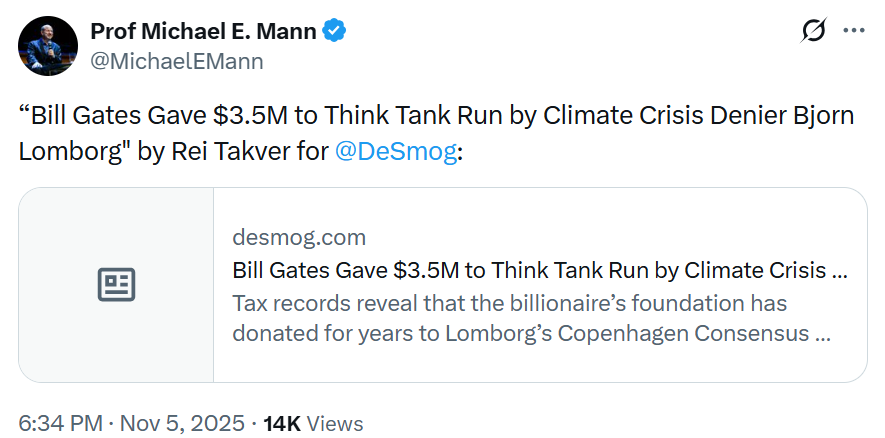
He could not help himself from taking the hockey stick to Gates on X. In one post, he went for a two-fer, attempting to smear both Gates and Bjorn Lomborg with an article from left-wing climate police and propaganda purveyor Desmog:
Former Vice President, internet inventor, and former Gates climate philanthropy bro Al Gore had this to say:
“I don’t know why [Gates] would do this … the only rave review of what he put out last week was from Donald Trump. Yeah, Trump loves it. That may be what Gates was shooting for.”

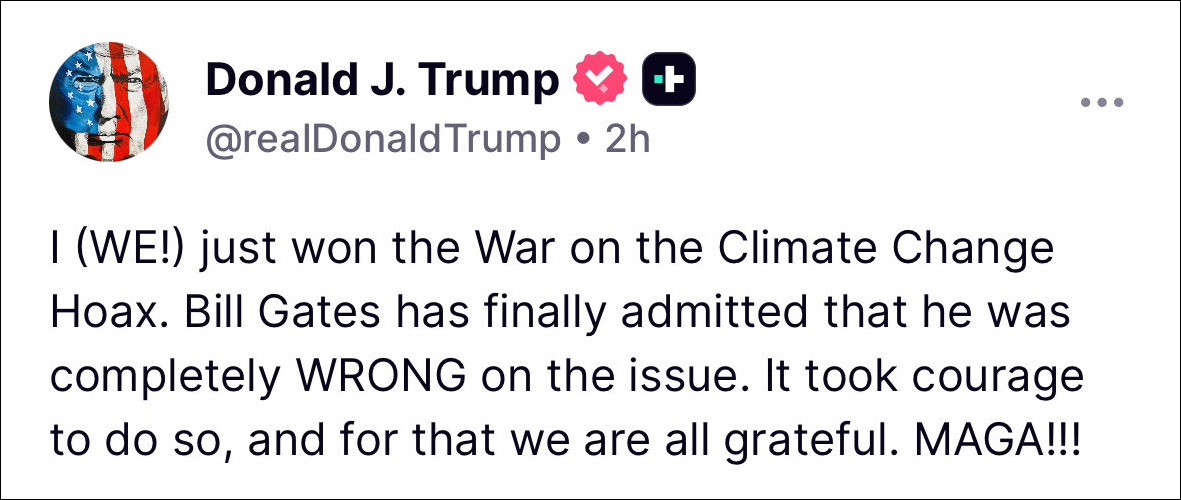
Speaking of which, at the other end of the spectrum, overreaction to the Gates memo from the opposing viewpoint was best displayed by Orange Man Bad himself. His interpretation and optimism might have been, how shall we say, just a tad “off.”
Two thoughtful reactions were provided by regular Substack energy content creators. In a post two days after Gates’ Three Truths, Roger Pielke, Jr. commented to his readers “these truths will be well understood, even common sense, and will seem neither shocking nor scandalous.”
Pielke, Jr. compliments Gates’ recognition that climate change is not going to be end of civilization. But he points out, as we noted in Part 1, that the reductions in future emissions scenarios Gates displays in Truth #1 are not because of the success of the Paris Agreement, or of “renewable” technology as much as something else:
“…not because the world has rapidly reduced emissions (as Gates incorrectly asserts), but rather because scientists have recognized that those extreme scenarios that have dominated climate research and policy were actually off target from the start.”
But for that important detail, Pielke, Jr.’s review of the Gates memo is reasoned and complimentary, buttressing each of Gates’ three “truths” with data and examples. He states, “From my perspective, Gates’ letter is a welcome contribution to a growing chorus of climate realism and energy pragmatism.”
Energy philosopher and unapologetic fossil fuel advocate Alex Epstein made the case that the Gates memo is a break in the “moral monopoly against fossil fuels,” a concept fleshed out in his 2022 book Fossil Future. No such “moral monopoly” existed in actuality, it was merely a widely held perception, fueled by incessant “appeals to authority” and “consensus” (a concept counter to the premise of actual science) based on the results of computer models, and incapable of standing up to the least bit of objective cost/benefit or risk-based analytical scrutiny.
Epstein was optimistic this faux moral monopoly would disintegrate under the weight of economic and physical reality, and “reframing” the energy/climate debate in terms of human prosperity. Credit Epstein along with Bjorn Lomborg, Robert Bryce, Doomberg and many others for their tireless efforts to successfully reframe the debate.
Reality caught up to the faux moral monopoly. Epstein considers the Gates memo a significant event in the energy humanism reframing, at least for the fact that Gates is the world’s largest philanthropist and barely three years ago published a book flirting with “existential crisis” rhetoric.
How do we view Gates’ missive? We take what he wrote at face value, believe his views are genuinely held and, despite some errors and disagreement with comments expanding on each of his “three truths,” find nothing controversial or incorrect in the three statements themselves, with which we enthusiastically agree. Regular readers of this Substack will not find that surprising.
What do we believe drove Gates reprioritizing poverty reduction over reducing emissions? A combination of factors.
Ove the last 25 years, through his philanthropic efforts, few (if any) on earth have donated more money to the admirable causes of health and poverty reduction in the developing world than Bill Gates. Some estimates put the figure at $65 billion or more, most of it through the Gates Foundation. About 150 companies focused in “clean tech” have received another several billion of Gates’ personal wealth through his Breakthrough Energy Ventures fund.
At the same time, few global business leaders and tech industry titans have been more vocal about the dangers of GHG emissions and climate change. Under Gates leadership, Microsoft set ambitious “net zero” goals, purchased billions in Renewable Energy Certificates to make it appear that the company was “100% powered by renewables”, and donated generously to climate activism and media enterprises amplifying the “existential crisis” narrative. Microsoft has largely maintained that course even after he stepped aside as CEO and Chairman.
Most of Gates philanthropic donations (by many estimates ~2/3rds) have been in Microsoft stock, over 700 million shares cumulatively since 1994, reducing his personal stake in the company from ~24% to <1% today. This is a common, tax-efficient means of donating wealth used by many successful billionaires, not unique to Gates.
Under the Internal Revenue Code, 501(c)3 (non-profit) entity recipients of donations of Microsoft stock from Gates Foundation or via Gates’ donations to Breakthrough Energy pay no taxes on the gain from the growth of stock they received up to the date of transfer. As such, Bill Gates has an obvious and significant personal interest in making sure his donations increase in value to the recipients he selected.
At the same time, as an unquestionably smart man, Bill Gates recognizes the physics and economic limitations of wind, solar, EVs and batteries as they related to providing always-on electricity required by Big Tech’s data and AI hyperscaler centers. In his Substack post, Alex Epstein came close to the core of the matter (emphasis ours):
“...it has turned out that AI’s effectively unlimited need for energy was the part of reality that has most broken the moral monopoly against fossil fuels.
The reason is that AI quickly generated a rapid increase in (highly influential) tech giants’ need for energy, specifically reliable electricity. This need quickly turned climate catastrophism and fossil fuel elimination from wealth-and-status benefiters for tech giants to wealth-and-status destroyers.”
How do all of these realities tie together into Gates’ memo? What’s the signal in all the noise surrounding it? The “tell” was actually in the 5,300-word manifesto for those who bothered read it:
“Although wind and solar have gotten cheaper and better, we don’t yet have all the tools we need to meet the growing demand for energy without increasing carbon emissions.”
(Read: “we” not only means you and me, it especially means Big Tech and AI).
Big Tech’s fate rests on the ability to get copious amounts of continuous high-quality electricity (at almost any price) 24/7/365, all 8,760 hours per year. Intermittency and lack of availability are simply not options.
The physics and economics of batteries paired with wind and solar cannot deliver that performance. The reason for Microsoft’s September 2024 power purchase agreement with Constellation Energy for the electricity generated by the restart of Three Mile Island’s unit 1 nuclear power reactor is hardly lost on its founder.
Bill Gates knows Big Tech is about to burn copious amounts of natural gas to provide the electricity demanded by data centers and AI hyperscalers, and that this will occur for some time before the U.S. (or Europe) bring significant new nuclear power generation capacity online. As we wrote in Nat Gas & Nuclear’s New BFFs in April 2024:
“What is the lesson here? You can have your AI, your data centers, your “clean tech” manufacturing, your EVs, and your reshoring semiconductors. But you can’t have it with an electric grid powered by 100% wind, solar, and hydropower in an advanced industrial nation like the U.S.
Natural gas and nuclear are about to become Big Tech’s new BFFs.”
Having read enough of his work we have no doubt that Bill Gates has sincerely held beliefs about the importance of energy to economic development and poverty alleviation in the developing world. But after nearly two decades of corporate climate activism Bill Gates needed a way to preemptively manage the accusations of hypocrisy that will accompany Big Tech’s inevitable abandonment of “renewables” and pivot to natural gas and nuclear energy. That pivot is both a physical, economic, and practical necessity and key to future growth in the price of Microsoft stock Gates has gifted to non-profits and used to fund Breakthrough Energy. A message centered around the ideas that “climate change” is not an existential crisis (but a problem), temperature is not the best way to measure progress, and health and economic growth and prosperity are the best defenses was a subtle way to do it.
Even though he no longer runs Microsoft and is no longer the company’s largest shareholder, much of the advanced world views Gates as inextricably linked to Big Tech. That reputational motive alone might explain his memo. A man in his position at his age worries about his legacy, in reputational terms and economic ones.
Selling it as somehow related to the broader societal good of alleviating poverty in the developing world is the hope. Energy humanism has a more altruistic appearance than protecting the investment you’ve made in charities by justifying Big Tech’s coming gargantuan hydrocarbon burn.
We close by noting that, as Alex Epstein commented in his Substack post, the anti-fossil fuel faux “moral monopoly” did not evaporate in the wake of Bill Gates memo. As the wreckage piles up from overreliance on “renewables” in the G7 nations, expect desperate appeals and a doubling down on the counterfeit morality of “net zero” to become more numerous and shriller.
The vast Climate Industrial complex that has been erected will not fall because one U.S. President changes policy direction and the world’s largest philanthropist changes priorities. The graft is so widespread and embedded like a tick in government, corporations, academia, and legacy media that is has become systemic.
There is a rich irony in the fact that Big Tech, as much or more than any other industry - through the purchase of Renewable Energy Certificates, funding for “renewables”, and climate advocacy - helped fund and create the pretense of the anti-fossil fuel “moral monopoly” Alex Epstein describes. And now that same faux moral monopoly stands in the middle of the highway, like a turtle under the thinnest of shells, with the tires of Big Tech’s tractor trailer full of hydrocarbons bearing down on it.
Energy humanism seems to be contagious, a good thing for the 7 billion people not yet living at western standards. We applaud Bill Gates for using his voice to say that reducing poverty by increasing affordable, reliable energy access is a higher priority than reducing CO2 emissions for those 7 billion people.
“Like” this post to send a message that lifting billions out of poverty is a higher priority than reducing GHG emissions.
Leave us a comment. We read them all and reply to most. Helps refuel the tank here.
Subscribe to environMENTAL for free below.
Share this post. Helps us grow. We’re grateful for the assist!
Michael Mann Resigns From UPenn After Smearing Charlie Kirk
Written by Craig Bannister on October 4, 2025. Posted in Current News
After reposting a comment calling slain conservative Charlie Kirk the “head of Trump’s Hitler youth,” media-heralded climate alarmist Dr. Michael Mann has resigned from his position at the University of Pennsylvania
In a statement announcing his resignation Monday, Mann said his activism conflicts with the university’s “established institutional neutrality policy.”
On September 14, The Daily Pennsylvanian reported on the widespread backlash to Mann’s Hitler/Kirk comparison:
“Penn Earth and Environmental Science professor Michael Mann faced criticism for social media activity — including reposts and a since-deleted post of his own — regarding the assassination of conservative media personality and Turning Point USA founder Charlie Kirk.
Mann’s comments on social media — including reposting a message that called Kirk ‘the head of Trump’s Hitler Youth’ — faced backlash from prominent conservative pundits and social media commentators, including Sen. Dave McCormick (R-Pa.). The posts have since been deleted.”
“This is despicable behavior,” Senator Dave McCormick (R-Pa.) wrote in a social media post condemning Mann’s smear of Kirk:
“This dangerous rhetoric cannot and will not be tolerated. I unequivocally condemn this behavior and demand UPenn to take immediate, decisive action.”
Mann, who had been Penn’s Vice Provost for Climate Science, Policy, and Action for 11 months before resigning this week, has long been a controversial figure stoking apocalyptic climate hysteria, according to Watts Up With That, which bills itself “the world’s most viewed website on climate”:
“Mann’s entire career has been one long exercise in not practicing neutrality. From the infamous ‘hockey stick’ graph that put him on the map, to his endless courtroom brawls against critics, Mann has thrived on confrontation.”
The Hockey Stick Graph (1998): Mann’s claim to fame, a reconstruction of past climate temperatures that conveniently erased the Medieval Warm Period. Critics shredded the statistical methods, but Mann doubled down and cast all skepticism as denial.”
See more here newsbusters.org
Editor’s note: the late, great Dr Tim Ball said numerous times Mann should be in the state pen rather than Penn State.
Key question, when the ecofascists hair catches fire, like it has here, does it increase CO2 release and are they accounting for that in their models?
it does feel as though the narrative is shifting to a more sensible belief set, and I applaud all who recognize that creating a world where the unlucky 7 billion are better off will require massive amounts of energy and we, the lucky 1 billion, have no business withholding it