

Scotch Double
Lee Zeldin and the Trump Administration choose to wrestle with the law, not the lab coats, and try to kill two birds with one shot.

For wingshooters, downing two game birds with a single shot, known in the sport as a “Scotch Double,” is almost always an exciting accident of good fortune. One usually does not see another bird flying closely adjacent to, and slightly downrange from, the one on which your eyes are sharply focused.
Sometimes, a second, faster flying bird crosses behind and a bit above or below your target just as you pull the trigger. The setup is rare enough that you can almost never plan it. Watch closely, it happens fast!
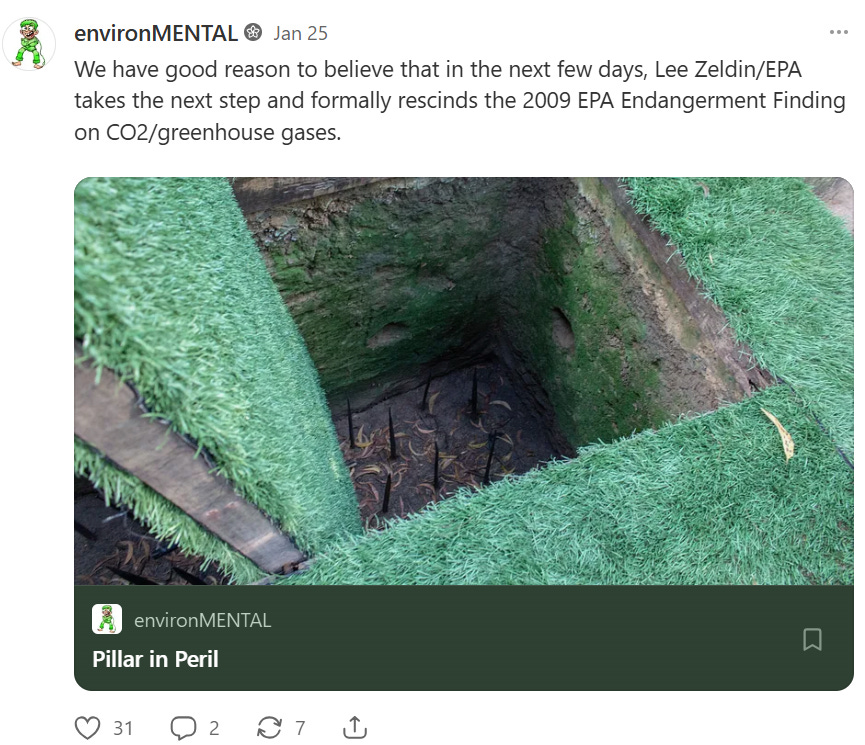
About a month ago, we received a tip that the U.S. Environmental Protection Agency (EPA) had submitted the necessary paperwork to issue the final rule to rescind the 2009 Endangerment Finding on greenhouse gases (GHG’s, including CO2) from new U.S. motor vehicles (the “EF”) to the U.S. Office of Management and Budget, a final step required prior to public release. On January 25, we posted the following on Substack Notes:
Eighteen days later EPA Administrator Lee Zeldin announced the agency was issuing the final rule. In the press release and live media event, Zeldin said the action would save American taxpayers $1.3 trillion and $2,400 per new car, and boasted it removes the off-cycle credit vehicle manufacturers use to reach the agency’s mileage standards, which created “the almost universally despised start-stop feature on vehicles.” He called the EF rescission “the single largest deregulatory action in U.S. history.” And had a few other choice words, on social media and in his presser with the President.
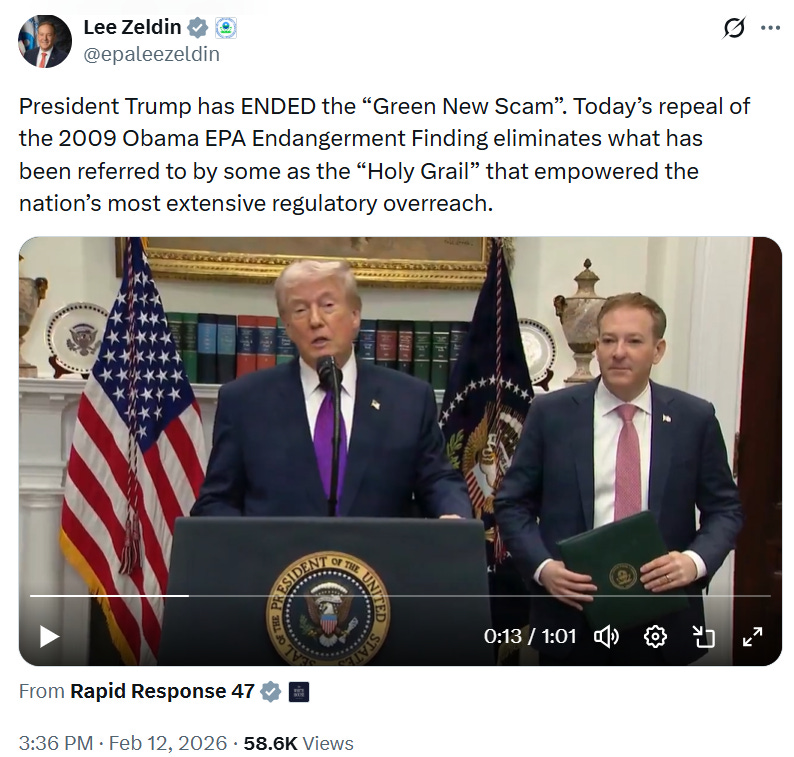
The complete 111 page EPA final rule was posted in the Federal Register last Wednesday, February 18 and can be found here. EPA’s webpage containing the additional resources and documents EPA included to support rescission of the EF can be found here.
Federal statutes allow 60 days to file petitions challenging EPA’s final rule to rescind the EF in the United States Court of Appeals for the District of Columbia Circuit (D.C. Circuit), the designed jurisdiction for such legal challenges. But health, environmental and other non-governmental organizations (NGOs) raced to file their petitions on the very day EPA published it. Given their strategy, Zeldin and the administration were surely pleased.
Pomp, circumstance, platitudes and promised savings aside, the published final rule details how Zeldin and the Trump administration intend to shoot down the EF. Included within are hints at their bigger objective: to knock down the more prized bird flying adjacent to it.
On what bases are Lee Zeldin, the EPA and the Trump administration rescinding EPA’s 2009 Endangerment Finding on GHGs? What basis did they intentionally choose to avoid, and why? And what Scotch Double is the Trump administration actually trying to pull off with this effort? Let’s roast some marshmallows over the fire emanating from “environmentalists’” hair together while giving you a pre-game program for the battle that has officially begun.
We begin with the final rule itself. Rescission of the Greenhouse Gas Endangerment Finding and Motor Vehicle Greenhouse Gas Emission Standards Under the Clean Air Act (the “Rescission”) is as notable for what is not in it as what is.
There’s an old adage in the South. Never wrestle in the mud with a pig. You’ll just get dirty and the pig will enjoy it. Zeldin clearly applied that rationale.
EPA’s August 1, 2025, Notice of Proposed Rulemaking (NPR or the “proposal”) officially kicked off the process. The proposal laid out two rationales for rescinding the EF, a “primary” rationale grounded in statutory and legal findings, and an “alternative” rationale grounded in “climate science.”
In two posts last year after the proposal was announced, Pillar in Peril and Game On, we provided readers with an overview of the 2007 Mass. v. EPA Supreme Court ruling that enabled the 2009 EF, the key subsequent Supreme Court rulings EPA is relying on to support its rescission, and the two rationales supporting the action. We also detailed how the several of the Court’s current Justices voted in Mass v. EPA, and changes in the Court since.
Game On provided an overview of a scientific report cited throughout EPA’s proposal. A Critical Review of Impacts of Greenhouse Gas Emissions on the U.S. Climate was prepared for the U.S. Department of Energy’s (DOE) by a Climate Working Group (CWG) consisting of several highly credentialed scientists.
After EPA’s proposal last August, a number of scientists outraged at the CWG report’s findings and EPA’s attempt to use them scrambled to prepare a rebuttal. Their refutation, led by Andrew Dessler and Robert Kopp - Climate Experts’ Review of the DOE Climate Working Group Report - required 85 scientists and 437 pages to “rebut” the 139-page report CWG produced with a total of four climate scientists and a Professor of Economics.
The cruel joke on Mr. Dessler, Mr. Kopp and the other eighty-three authors, who dropped everything to produce something three times as long requiring 17 times the number of authors as what they were rebutting, all in thirty days. According to the final rule published in the Federal Register February 18th, EPA rescinded the EF based solely on the primary – statutory/legal – rationale, not the alternative, scientific one.
Like poachers shooting at a Styrofoam decoy game wardens set out to attract fire, the shots fired by Climate Experts Review were for naught. As we noted in Pillar in Peril and Game On, “the science!” is not where this battle was ever going to be fought.

Zeldin’s strategy avoids the scientific mud wrestling match. As EPA explained in the final rule issued last week:
“Although the Administrator continues to harbor concerns regarding the scientific determinations underlying the Endangerment Finding, the EPA has decided not to finalize this scientific alternative rationale at this time.
EPA is rescinding the Endangerment Finding based on the best reading of CAA section 202(a)(1), under which the EPA concludes that Congress did not authorize the Agency to regulate GHG emissions from new motor vehicles and engines in response to global climate change, and, separately, is repealing the GHG emission standards for the additional reason that futility renders it unreasonable to retain the standards. These legal conclusions are sufficient to support rescission of the Endangerment Finding and repeal of the related GHG emission standards without the additional scientific basis set out at proposal.”
The final rule details the three rationales EPA relied on to rescind the EF.
First, the agency finds section 202(a) of Clean Air Act is best read to a) authorize EPA to “identify and regulate ‘air pollution’ that threatens to endanger health and welfare through local and regional exposure,” and b) require EPA to issue emissions standards in conjunction with findings of endangerment, rather than sever the two steps. Here, EPA applies traditional tools of statutory interpretation “as informed by the Supreme Court’s decisions in Loper Bright v. Raimondo and Utility Air Regulatory Group v. EPA.”
Loper Bright destroyed the Chevron doctrine, essentially reigning in agency’s authority to regulate where statutes are ambiguous and Congress’ intent unclear. UARG clipped EPA’s wings for trying to rewrite numerical emissions thresholds set by Congress in the CAA, “tailoring” them in order to only regulate large CO2 emitters. Both decisions, rendered by the current 6-3 conservative Supreme Court, are foundational to the EF rescission.
Second, EPA finds that the language in CAA Section 202(a) “lacks the clear congressional authorization required for the EPA to assert authority to regulate GHG emissions in response to global climate change concerns.” Here, the final rule holds out the Supreme Court’s specific application of the “major questions” doctrine in the UARG and West Virginia v. EPA decisions as support.
Third, EPA finds that “the Agency should not and need not make an endangerment finding under CAA section 202(a)(1) when exercising the regulatory authority conferred by that provision would have no meaningful impact on the identified dangers.” Here, Zeldin asserts the statute only authorizes regulation of GHG emissions from new U.S. motor vehicles if they represent more than a de minimis contribution to global concentrations. Further, “even a complete elimination of all GHG emissions from new motor vehicles and engines would not address the risks attributed to elevated global concentrations of GHGs,” and as such regulation is futile.
Importantly, EPA notes that each of these findings “is severable, and each basis alone provides sufficient justification to rescind the Endangerment Finding,” an attempt to ensure its legal durability even if one or two of the rationales fail to survive legal challenge. The rule will become effective on April 20, 2026, unless stayed by legal action. (Readers interested in the details of EPA’s rationale can find them in pages 25 – 49 of the final rule.)
Legal petitions challenging the action must be filed in the DC Circuit within 60 days of publication in the Federal Register. On the same day that EPA published the final rule, the American Public Health Association along with 16 other environmental and health-related NGOs (including The Center for Biological Diversity, Conservation Law Foundation, EDF, Friends of the Earth, Natural Resources Defense Council, Sierra Club, and the Union of Concerned Scientists) filed their petition.
Eighteen children from Alaska, California, Colorado, Hawaii, Montana, New York, Pennsylvania, Tennessee, Washington, and Wisconsin represented by Our Children’s Trust filed a separate petition, citing specifically violations of their First, Fifth and Tenth Amendment rights, as well as the “Religious Freedom Restoration Act.” According to lead petitioner Elena Venner:
“The EPA’s repeal of the endangerment finding violates my first amendment right to practice my faith and my fifth amendment rights to life and liberty.”
You will pardon us for wondering how the practice of one’s faith relies on any EPA determination or regulation.
The two cases are likely to be consolidated in the DC Circuit Court. Procedural orders, stay motions/briefing (e.g., Petitioners seeking to stop effectiveness pending final legal resolution), EPA certifying the administrative record, merits briefings and proceedings and the like mean that a decision from the DC Circuit in 2026 is unlikely. Even an expedited case might not conclude until the latter half of 2027.
Whoever loses the case in the DC District is almost certain to petition the Supreme Court for certiorari (to accept for review from the lower Court). An environmental legal expert we trust says he believes the Supreme Court would be highly likely to grant certiorari to decide a case with such significant economic ramifications.
We are not qualified to predict the outcome. But Zeldin and the administration are eager for the chance to put their case before a Supreme Court they view as favorable after its UARG, Loper and West Virginia decisions, upon which EPA’s final rule to rescind the EF relies heavily. Their plan is designed to bring down not only the EF, but the real prize flying alongside it.
We close by noting that Zeldin’s final rule frames the EF as inconsistent with the Supreme Court’s rulings in West Virginia and UARG (major questions doctrine) and Loper Bright (removing Chevron deference for agencies), all of which were decided after the 2009 EF. By doing so, EPA is effectively asking the Supreme Court to reexamine its Mass v. EPA conclusion that greenhouse gases meet the definition of “air pollutants” under the Clean Air Act.
Zeldin and the administration are trying to kill two birds with one shot: the 2009 Endangerment Finding and the 2007 Mass. v. EPA decision that unleashed it. More than a few legal scholars see the latter as a real, if unlikely, possibility:
Elizabeth Albright, Dan and Bunny Gabel associate professor of the practice of environmental ethics and sustainable environmental management, thinks last week’s repeal will draw lawsuits from states and environmental groups around the country that may set the stage for Massachusetts v. EPA to eventually be overturned. .. in the event Massachusetts v. EPA is overturned, Congress would have to pass a new law for the federal government to be able to regulate greenhouse gases again.
Forcing Congress to pass legislation to regulate CO2 and GHGs while removing future administrations’ ability to do so absent clear instruction from Congress is the real prize. It is the deeper purpose of the Trump administration’s effort to rescind the EF.
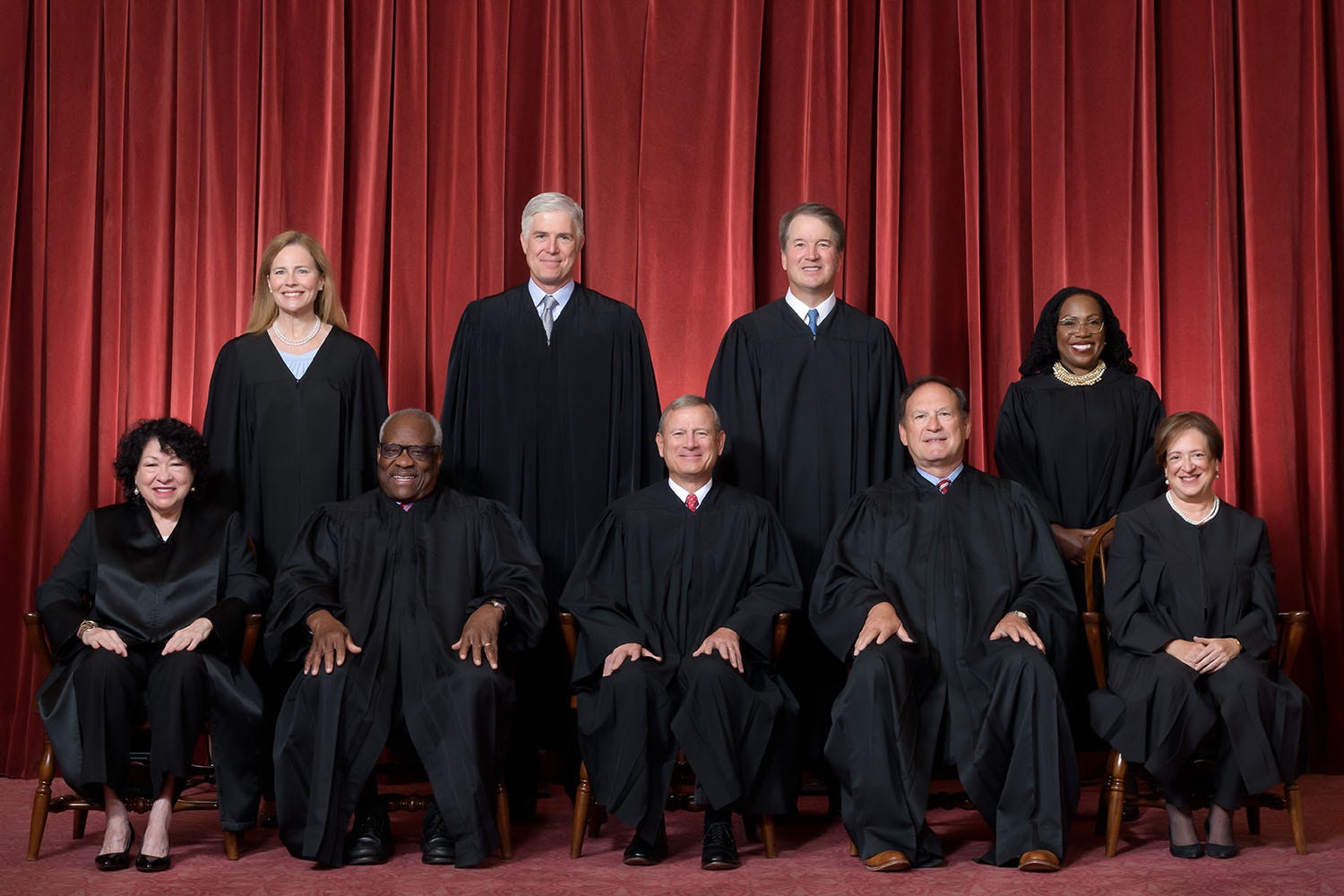
Of the five Justices who rendered the (narrow) 5-4 Mass. v. EPA decision (2007), exactly none remain on the Court. Three dissenting Justices – including Chief Justice John Roberts - are still serving, and all joined Justices Kavanaugh, Coney Barret, and Gorsuch in the 6-3 West Virginia v. EPA (2022) and Loper Bright (2024) decisions. In UARG (2014), Roberts, Thomas and Alito found with the majority, with Kagan and Sotomayor dissenting.
For nearly twenty years, the 2009 Endangerment Finding on greenhouse gases has winged its way through challenges intact, with the Supreme Court’s 2007 Massachusetts v. EPA decision flying alongside and seemingly safe immediately down range. Changes in the makeup of the Supreme Court and its subsequent rulings cause the Trump administration and Lee Zeldin to see this as a moment in time when the two are flying close enough to be brought down together with one shot. The gun is coming to shoulder, and you can see the gleam in their eyes.
Will it be a Scotch Double for Zeldin and the Trump? Or the agony of defeat and a long drive home in the President’s limo with a wet dog’s tail beating their faces in humiliation because they whiffed?
You’ll have to be patient to find out. Sorry, we don’t control the timeline.
“Like” this post to show your support for bringing back unadulterated V8 engines and 5/6 speed transmissions in large 4X4 pickups and SUVs.
Leave us a comment. We read them all and reply to most. Refuels the tank here.
Subscriptions to environMENTAL are free, but please consider supporting our work by becoming a paid subscriber.
Share this post. Helps us grow. We’re grateful for the assist.
“The EPA’s repeal of the endangerment finding violates my first amendment right to practice my faith and my fifth amendment rights to life and liberty.” 🤣🤣🤣
If one ever needed proof that “climate change” is a religion, the statement that repealing the endangerment finding violates first amendment rights (religion and speech) proves it.
certainly, my fingers are crossed the administration is successful