

Outmaneuvered
A recent Supreme Court decision. A decades old Superfund cleanup liability case. What do they have in common? State climate litigants are about to find out in ways they probably won't like.

“Perseverance, secret of all triumphs.” - Victor Hugo
Fullerton, California is a mid-sized city about 25 miles southeast of downtown Los Angeles in northern Orange County. With median home values of around $900,000 and average household income of about $105,000, Fullerton is a diverse, middle-to-upper-middle-class suburban neighborhood.
On the northwest side of town, straddling the border with the city of Buena Park, the ~100-acre Ralph B. Clark public park sits at the foot of the West Coyote hills. With athletic fields, tennis courts, sand volleyball courts, an amphitheater overlooking a lake stocked for fishing, multiple children’s playgrounds, and hiking trails among other amenities, it is a popular local attraction. Interestingly, within the park historic evidence of saber-tooth cats and mammoths has been unearthed.
Located on the south side of Rosencrans Avenue about half a mile east of Beach Boulevard (State Road 39), Clark Park sits adjacent to the Los Coyotes Country Club golf course’s three 9-hole tracks. Neighborhoods of residential homes effectively bound the park and country club completely to the east, west and south. A quick Zillow search suggests home values surrounding the park and country club in a range from about $1.3 million to over $3 million.

Houses along one side North Fairgreen Drive and Tiffany Place are adjacent to three Los Coyotes golf holes in the northeast most corner of the club property, like this four-bedroom, two bath, 2,653 square foot home with a pool on Tiffany Place. For a bit over $1.5 million, with annual real estate taxes of “only” $10,500, and for the pleasure of $6.50/gallon local gas prices and the highest electricity costs in the continental U.S., this could be your little piece of heaven near the foot of the West Coyote Hills.

What you wouldn’t know from the Zillow description is that the house is adjacent to one of the State’s first and most notorious National Priorities List (NPL) sites under the federal Comprehensive Environmental Response, Compensation, and Liability Act (CERCLA), also known as “Superfund.”
CERCLA is the federal law enacted in 1980 that imposes liability for cleanup costs on arrangers and transporters of hazardous substances, and on current and former owners of facilities where hazardous substances were disposed. NPL sites by definition are “national priorities” due to the higher risks they pose to human health and the environment. They are the “worst of the worst” of the bunch.
The matter of who ultimately paid for most of the cleanup at the McColl Superfund NPL site in Fullerton, and by what legal means, and a unanimous decision in an unrelated case rendered by the U.S. Supreme Court April 17th are connected in ways few have considered. But for major U.S. energy firms facing increasing civil litigation alleging past and future “climate damages” in state courts, the recent Supreme Court ruling working in conjunction with legal precedents established in the McColl NPL case has significant implications.
State attorney generals, environmental non-governmental organization (ENGO) zealots representing “climate-injured” youth, and any other climate litigants who might have legal standing to bring climate-related lawsuits in state courts may have just been outfoxed. If so, it will turn out to be one of the cleverest legal maneuvers ever by western energy majors in U.S. courts.
What did the U.S. Supreme Court say in Chevron v. Plaquemines Parish, etal? How is the McColl Superfund site case relevant? And how might the legal strategies from both cases combine to thwart the growing wave of state litigation against major energy firms, or possibly even make your tax dollars pay for it? Let’s make a cross-country trip - from Fullerton to coastal Louisiana to the halls of the nation’s highest court in D.C. - to connect these two cases and show you how the legal theories involving both may soon work in tandem to produce outcomes few seem coming.
We begin in Fullerton, which developed as a citrus center after the arrival of the Sante Fe Railway in 1888. A few years prior, the Brea-Olinda oilfield had been discovered about four miles north of town.
By the year 1900 oil field production in Kern, Los Angeles and Fresno Counties to the north was booming. In 1903 California became the nation’s leading oil-producing state, later trading the top spot with Oklahoma for many years. But production from the Brea-Olinda field did not really take off until the 1920’s and 1930’s. And then the Japanese invasion of Pearl Harbor in December 1941 changed everything.
At the time of the Pearl Harbor attack that brought America fully into WWII, the U.S. was only producing about 40,000 barrels per day (bpd) of the 100-octane aviation gasoline (avgas) critical to the war effort, but the U.S. military determined it would rapidly need over 190,000 bpd of the fuel, and ultimately much more. With the “win at any cost” ethos at the time, the federal war apparatus had to secure critical supplies of a wide variety of materials, but sufficient, on-demand avgas supply was deemed critical to victory. The capacity to refine that much avgas, however, simply wasn’t there, and American refiners could not justify the enormous capital investment (over $15 billion in today’s dollars) required to meet the military’s needs.
The solution was money and contracts. The U.S. government agreed to pay all the refiners’ costs to produce the avgas in return for their accepting a reduced profit margin and agreeing to government restrictions on private market production and sales. But as part of that bargain, the refiners demanded something else from the government, and they got it.
In what became known as “the grand bargain,” the oil companies got the government to agree to not only pay all the costs of producing the avgas, but also to assume contingent future regulatory costs they might face as a result of their production of avgas for the WWII effort. The “Avgas Program” was implemented via supply contracts between the oil companies and the Defense Supply Corporation (DSC), which gave the government broad control over the industry through the Petroleum Administration for War. (We sincerely hope we have not just given President Trump any big ideas.)
At the time, there were essentially no environmental regulations of any meaningful force in America (or Europe or the UK, for that matter). It would be decades before the National Environmental Policy Act, Clean Air Act, Clean Water Act, CERCLA, the Resource Conservation and Recovery Act (RCRA) and other major environmental regulations would come into force. As such, the second and third order consequences of agreeing to virtually anything to get those fuels to win WWII could not have been foreseen, and the government was so desperate for avgas to win the war that it effectively threw all caution to the wind with the breadth of the indemnity obligations it assumed in the supply contracts.
Because America’s entered WWII in the Pacific theater after Pearl Harbor, and California had become an oil producing powerhouse, it was natural that many of the DSC contracts went to west coast refiners. In addition to California’s geologic endowment, the Port of Long Beach’s location so close to California oilfields was an enormous natural strategic military advantage.
The major refiners delivered. By the time WWII ended, the Avgas Program was producing an amazing 500,000 barrels per day, more than ten times U.S. output prior to its start.
How critical was 100-octane avgas to winning the war? In 1943, Great Britain’s Petroleum Secretary, Geoffrey Lloyd, commented that “we wouldn’t have won the Battle of Britain without 100-octane…”. In that context, “the grand bargain” certainly looked like a bargain at the time.
This is where the northeast corner of Los Coyotes Country Club’s property and the lovely homes around it like the one above enter the story. At the time, that acreage was owned by a fellow by the name of Eli McColl, and old Eli was nothing if not a businessman.
Refining avgas (or any other product) from crude oil back then was not exactly a pristine business. It generated a lot of nasty waste, and in the early 1940’s, no western nation yet had any meaningful environmental laws or regulations. All that avgas refining waste had to go somewhere.
Enter Eli McColl, who owned a section of the old Emery Ranch northwest of Fullerton. In an arrangement that was neither illegal nor uncommon at the time, McColl contracted with Shell Oil Company and other WWII-era refiners such as Atlantic Richfield (ARCO), Texaco, and Union Oil (Unocal) to haul acidic sludges and other hazardous byproducts of high-octane avgas refining by truck for disposal on twenty-two acres of his land. McColl then had 12 pits constructed specifically to receive the waste.
Between 1942 and 1946, 72,600 cubic yards of this waste were deposited in the 12 unlined pits, or sumps, on McColl’s land, with total contaminated waste material estimated at around 100,000 cubic yards. (For context, the typical tandem-axle dump truck holds about 12-14 cubic yards of material like dirt or gravel).
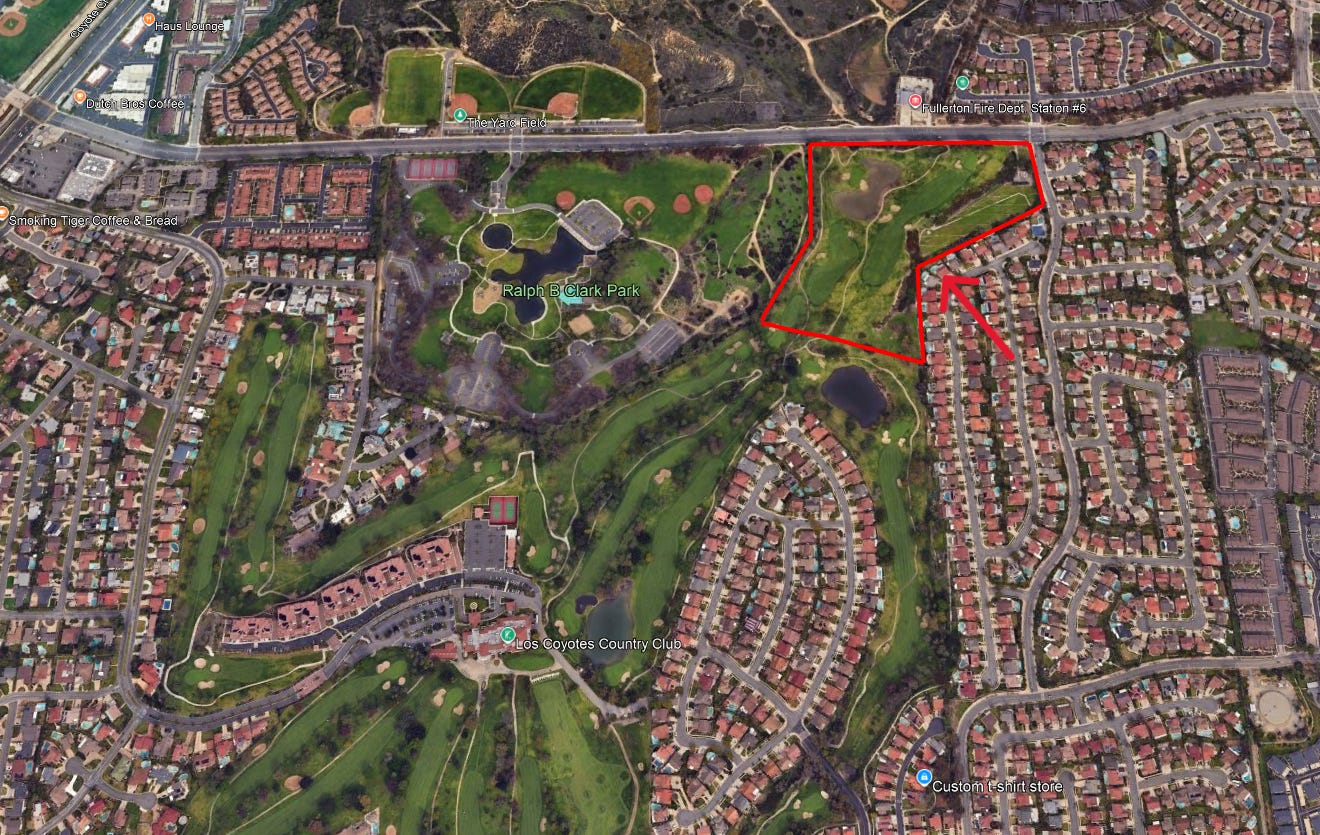
Most of the waste originated from nearby Shell, ARCO, Texaco, and Unocal refineries. The satellite image below shows the approximate boundaries of the McColl Superfund NPL site today, with the arrow pointing at the Zillow property pictured above.
Surely thinking himself an astute businessman, old Eli likely figured he’d get ‘em going and coming. After neighbors complained about odor, he covered some of the pits with oilfield drilling muds and fill dirt. Later, as Fullerton grew, he tried to cover all of them in order to capitalize on selling or redeveloping the land, adding soil during construction of part of Los Coyotes golf course as it expanded.
Homes were built nearby in the 1970’s, and by the late 1970’s, residents began complaining of odors and health issues to local and state authorities. To make a long story short, by the time the environmental investigations were done, CERCLA had become law, and in the fall of 1983, when the U.S. Environmental Protection Agency (EPA) created the nation’s first list of Superfund’s notorious NPL sites, the McColl Dump Site was on it.
In 1991, EPA and the State of California filed suit against Shell, Texaco, Unocal, and ARCO to recover their costs of investigation and remediation under Superfund’s section 107(a) cost recovery provisions. In 1993, a California District Court held the four oil companies and good old Eli McColl jointly and severally liable for past and future response costs, including the ~$25 million EPA and the State of California had already spent, and future costs that would surely be much higher. Because of CERCLA’s joint and several liability, Eli McColl’s business(es) likely paid little if anything, and as far as EPA and California were concerned, he might as well have been a turnip. Once EPA has deep pocket large corporations on the hook as “responsible parties” (RPs), the smaller, less solvent, and/or insolvent parties are, in an economic sense, little more than part of the legal file (their former Commercial General Liability insurers, however, may not enjoy such privileges).
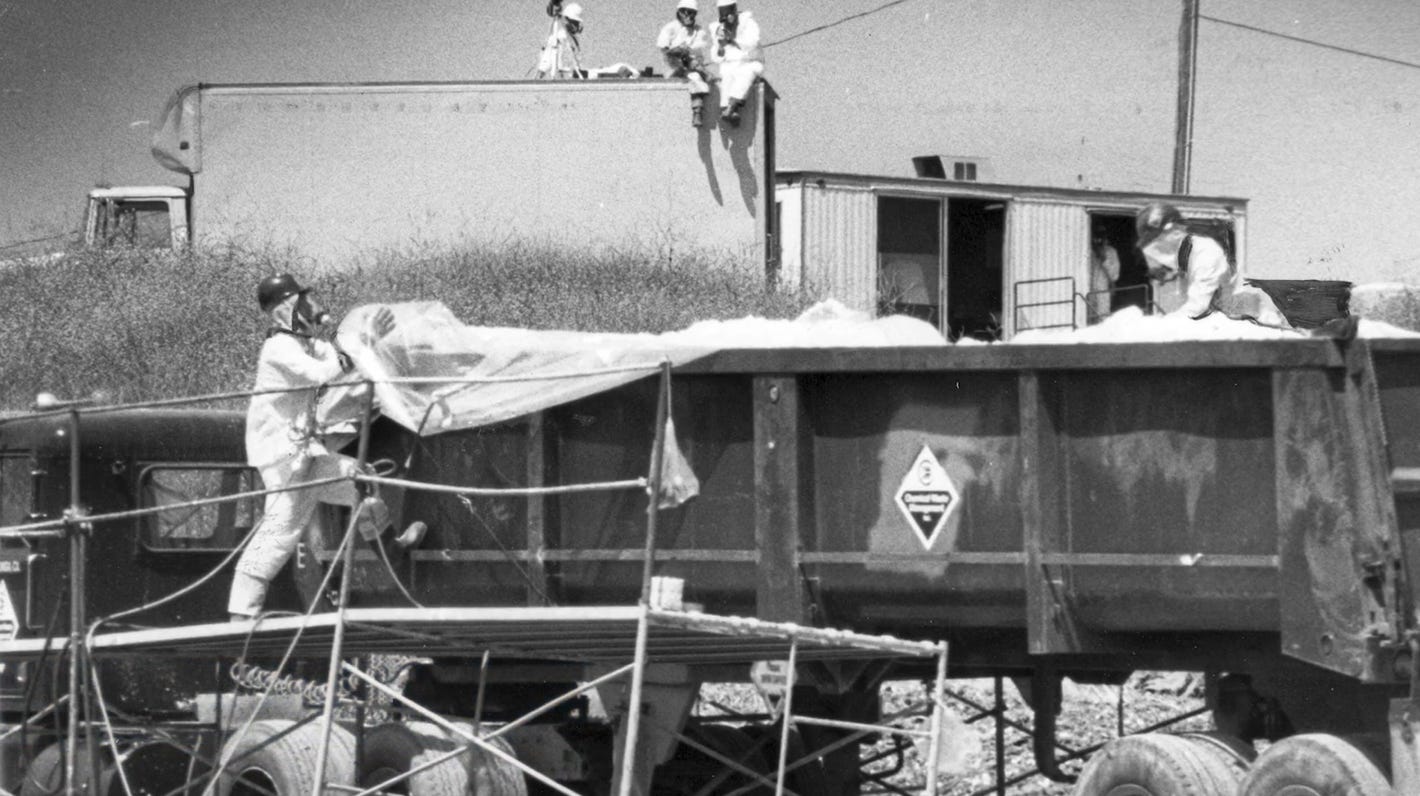
The remediation cost nearly $100 million between what the four major oil RPs, EPA, and the State of California spent. Readers interested in the details of the soil and groundwater remedies can find an overview on EPA’s website. The picture below is from McColl site remediation efforts during the 1990s:
Extensive, complex litigation and settlements ensued. In 2010, Texaco and Unocal were severed from EPA’s cost recovery suit due to corporate restructuring and liability shifts, but Shell, Chevron (as successor to Texaco and Unocal) and BP (successor to ARCO) all settled with the State of California at the end of 2021, paying $8.1 million for the state’s response costs from 1990 through March of that year.
But Shell had good records, long memories, seasoned in-house attorneys and plenty of four-figure-per-hour expert outside ones happy to help them. They remembered those DSC contracts from WWII, and in particular their broad indemnity provisions. And that’s when things got interesting (emphasis added):
In February 2006, the refiners brought an action in the U.S. Court of Federal Claims seeking to recover the McColl site cleanup costs, claiming that the WWII DSC avgas supply contracts required reimbursement under a provision entitled “Taxes.” They claimed that the provision was not limited to tax reimbursements because the contracts obligated the government to pay “any new or additional taxes, fees or charges…which Seller may be required by any municipal, state or federal law…to collect or pay by reason of the production, manufacture, sale or delivery” of avgas. The refiners argued that the McColl cleanup costs were new “charges” imposed by Congress under CERCLA that they incurred because of the production and manufacture of avgas under the DSC avgas contracts. Thus, they argued that the government was obligated to reimburse the McColl cleanup costs.
The federal government disagreed. It argued that the “taxes” language applied to tax-like charges, that any other interpretation would impose enormous costs on the government through essentially unlimited indemnities that weren’t part of the “grand bargain,” and any recovery was barred by the Anti-Deficiency Act because Congress had not appropriated funds for the claimed costs.
The Court of Federal Claims ruled for the government on all issues, but the oil companies appealed to the U.S. Court of Appeals for the Federal Circuit. In April 2014, a panel of that court ruled 2-1 in favor of the oil companies that the CERCLA costs at McColl did indeed constitute taxes or charges under the DSC contracts. The ruling forced the federal government to live up to the promises in the contract more than 70 years earlier.
The government petitioned the Federal Circuit Court for an en banc hearing, but the petition was denied in August 2014. When the smoke cleared, the government had extracted between $50 and $80 million from the oil companies through CERCLA cost recovery but was ultimately ordered to reimburse the oil companies for nearly $100 million under the WWII contracts for their remediation expenditures at Eli McColl’s waste dump.
In January of this year, our friend and outstanding writer Trevor Casper’s post Delta Dawn described many of the activities that have contributed to the loss of coastal Louisiana land and wetland complexes over many decades, some man made, some natural. To be sure, the canals that were cut into the coastal marsh to facilitate oil and gas exploration and production allowed saltwater to intrude deeper into the fresh and brackish water marshes, and some abandoned wells and equipment remain, so some damage is certainly attributable to oil and gas company activities. But as Trevor notes in Delta Dawn, enormous freshwater flows were being diverted for flood control and navigation in many places throughout the lower Mississippi River basin decades earlier. Determining which damages were caused by projects undertaken by the federal government via the U.S. Army Corps of Engineers for navigation and flood control purposes vs. those caused by digging canals and using them for oil and gas exploration and production vs. natural geomorphological evolution is hardly more than educated guesswork with computers, if not impossible.
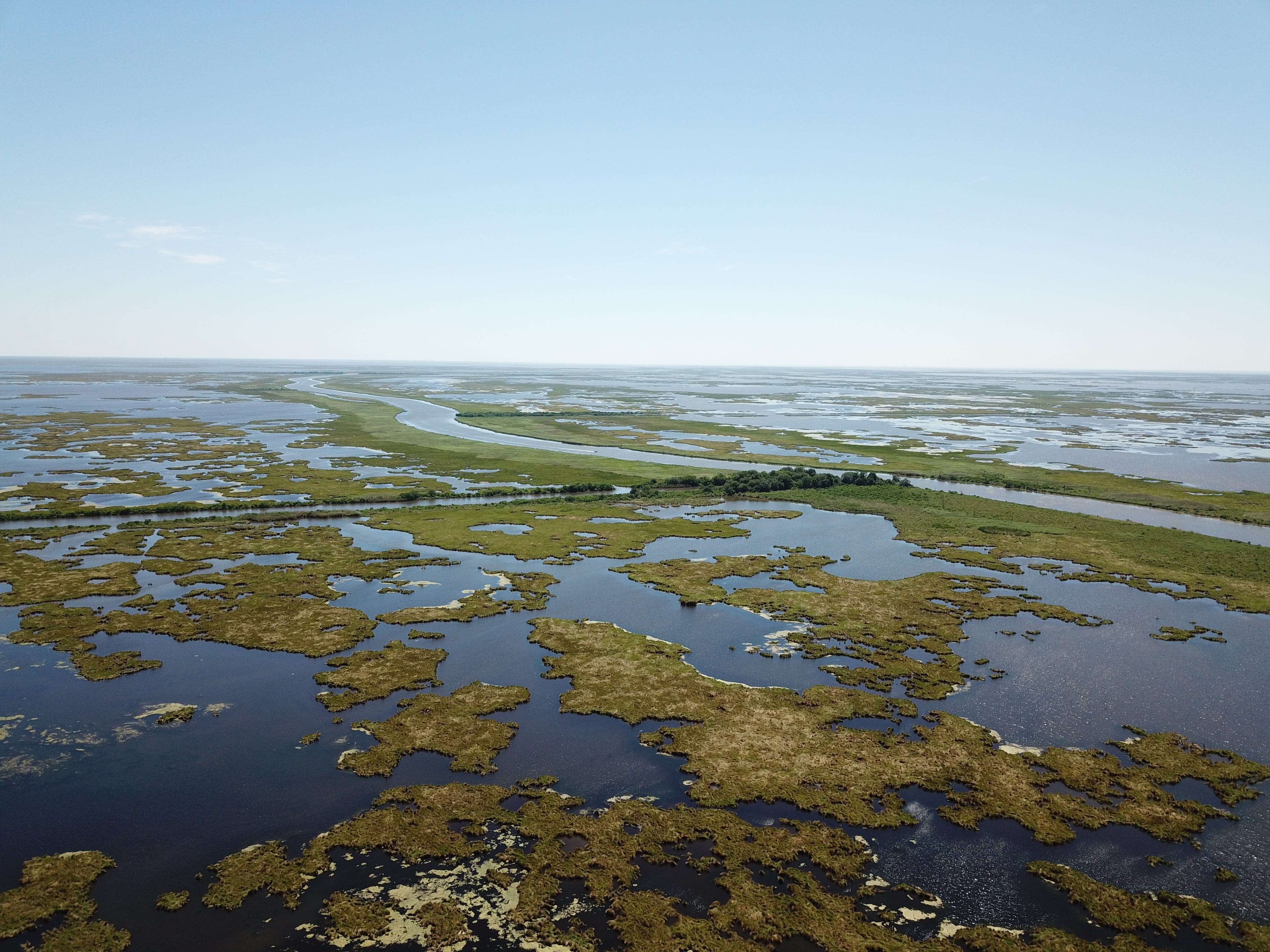
Make no mistake, coastal wetland and upland land loss is a significant issue all across Southern Louisiana. The questions are the causes and the best remedies. These are sensitive systems that range from fresh, to brackish, to salt across as transition toward the coast. Previous attempts to restore marsh using funds allocated for that purpose from the 2010 BP Macondo well blowout in the Gulf of Mexico have had at best limited results. All of these, and other relevant considerations are noted in Delta Dawn.
In 2013, one year before the Federal Circuit Court ruled to force the federal government to live up to its WWII Avgas Program contract commitments at the McColl Superfund site, Plaquemines Parish and others filed 42 lawsuits in Louisiana state court alleging ecological damage to coastal lands and wetlands against Chevron and 200+ other oil and gas companies under the Louisiana State and Local Coastal Resources Management Act (SLCRMA). The 1978 state law prohibits certain uses of Louisiana’s coastal zone without a permit, including oil production, but contains an exemption for legal uses commenced prior to 1980.
The Parish alleged that the companies lacked permits and that some uses, even if initiated before 1980, were illegally commenced and therefore not covered by the exemption. Critically, at one point during the litigation, the Parish filed an expert report which made it clear that it intended to challenge certain defendants’ crude-oil production during the Second World War (hint: McColl Superfund site above.)
In December 2013, one month after Plaquemines Parish sued them, Chevron attempted to remove the matter from the Louisiana state court system to the federal courts, filing a Notice of Removal in the federal District Court for the Eastern District of Louisiana (EDLA) under the “federal officer removal” statute. The law allows persons (in this case corporations) acting under direction of federal officers and agencies to remove civil or criminal cases from state court to federal court when the claims arise from acts performed “under color of” federal office. The effort failed and the case was remanded back to state court.
But Chevron did not give up easily. Critically, its initial attempts to have the case removed to federal court were not based on its World War II-era contracts to refine crude into avgas for the military but grounded instead in other federal Acts and legal theories that fell short.
But in May 2018, Chevron changed tactics. This time, it filed for removal again under the federal officer removal statute in the same federal court which rebuffed its earlier attempts, but this time using the same WWII era Avgas contract indemnities at issue in the McColl Superfund case.
Meanwhile, one of the initial Louisiana state lawsuits against Chevron and other oil companies proceeded to jury trial, and in April 2025, (to the surprise of few) a jury in Plaquemines Parish state court rendered a $745 million verdict in favor of Plaquemines Parish. The bulk of the verdict related to coastal land loss, with smaller portions allocated to environmental contamination and abandoned wells and equipment.
Chevron succeeded removing the Plaquemines Parish suit to federal court in the EDLA and argued that the litigation was “related to” its duties to refine crude under its contracts with the government. The District Court rejected the argument and remanded the case back to state court.
A 2-1 panel of the U.S. Court of Appeals for the Fifth Circuit affirmed the District Court’s decision in spring 2024, finding that Chevron had “acted under” a federal officer in its military contract, but that the suit was not “for or relating to” those acts since Chevron’s contract did not specify how to obtain the crude needed for refining. The full Fifth Circuit denied Chevron’s request for rehearing en banc on the last day of October 2024.
But Chevron still was not done with the matter. It petitioned the U.S. Supreme Court for certiorari in January 2025. Last June the Court granted Chevron’s petition, and the case was heard on January 12th this year.
Just under two weeks ago, on April 17th, the Supreme Court overturned the Fifth Circuit decision and rendered a unanimous decision (8-0, with Justice Alito recusing himself) in favor of Chevron, finding that the company had (emphasis added):
“...plausibly alleged a close relationship between its challenged crude-oil production and the performance of its federal avgas refining duties—not a tenuous, remote, or peripheral one—and has therefore satisfied the “relating to” requirement of the federal officer removal statute.”
The Supreme Court remanded the case to the Fifth Circuit, where its effective role will be to eat crow and formally order removal of the litigation to federal court. It will most likely land again in the federal EDLA. The federal District Court will have to decide the matter on the underlying merits — Are Chevron and the other energy company defendants liable under federal common law or other applicable law for the claimed coastal Louisiana damages?
Before that can even occur, now that the matter is in federal court the SLCRMA state law claims and their $744 million verdict will face federal preemption challenges. The tests are critical gating issues, and energy companies will argue that the Outer Continental Shelf Lands Act (OCSLA), the Clean Air Act, and other federal laws displace Louisiana’s ability to impose liability for the challenged conduct. OCSLA’s is a primary preemption tool for coastal damage claims, something particularly relevant in the Plaquemines parish case. Because removal and final-judgment issues are legally distinct, the plaintiffs will try to argue that the final judgment survives removal to the federal courts. But if federal law preempts the state law claims, then Plaquemines Parish and the other plaintiffs may have no viable cause of action. Net result: the $744 million verdict would not simply be retried; it would be extinguished.
The strategy is a high-leverage play. The 42 state cases are most likely to be consolidated into a multi-district litigation case in the federal EDLA, with bellwether trials and a single judge ruling once on preemption. That means in one preemption ruling the legal question at issue across all 42 cases could be disposed of simultaneously.
You can see why Chevron was so persistent.
Assuming that the District Court finds that federal law does not preempt the state law claims, then it is left to decide – under new and separate proceedings - whether Chevron, etal are liable for the alleged coastal damages and, if so, the extent of the damages. The federal rules of procedure and damages framework are both more deferential to Chevron – and worse for the plaintiffs - than those in Louisiana’s state court system. The federal Daubert standard excludes weaker expert causation reports. Federal common law on causation/damages versus Louisiana tort law makes the plaintiffs’ burden higher. A federal jury drawn from the EDLA is not as likely to be quite as deferential as one drawn from state court in Plaquemines parish. And the damages methodology changes from SLCRMA’s restoration-cost basis to something more akin to diminution-in-value or CERCLA or OCSLA natural resource damage assessments.
And this is where Shell vs. U.S. and the McColl Superfund site converge in ways that could shape the legal landscape for climate-related damage suits in state courts for years.
If the cases were to succeed on the merits in Federal Court, and the court rules that climate-related tort damages qualify as “new-or-additional charges” under the DSC avgas contract indemnity language, then absent any ruling overturning that finding at the federal appellate court level or ultimately the Supreme Court, some - and potentially a lot - of the damages awarded against energy companies in state climate litigation could end up being reimbursable under the contracts. For energy companies, here’s how that might work.
The first step would require an energy company to succeed in having the state case removed to the federal court system under the federal officer removal statute. Under the standard set by the Supreme Court on April 17th, the company would argue that its oil production during all periods in which it had a federal contracting relationship relative to the allegations bears a “close, non-tenuous relationship” to its refining activities. The new standard set by the Supreme Court does not require that the activities directly caused the harm, only that the challenged conduct “relates to” the acts performed under federal direction. It would still have to meet the other required elements of the federal officer removal test:
It acted under a federal officer (something like the DSC, or the Defense Logistics Agency today).
The charged conduct is related to that federal direction.
It has asserted a colorable federal defense.
The last of those elements is where other Federal Courts (the Fourth and Ninth Circuits in climate cases involving Baltimore and Honolulu, for example) have held that state-law climate tort claims do not sufficiently implicate a federal defense to support removal to federal courts. The Supreme Court’s decision in Chevron vs. Plaquemines Parish does not resolve the court split, but its broadening of the “relating to” language now puts energy companies in a stronger position to assert federal officer removal in state climate cases.
The second step would involve a crossclaim or third-party claim by the energy companies against the United States — brought parallel to the underlying tort case and drawing the Department of Justice into the damages phase. Energy companies will claim that climate-related tort damages — coastal wetland loss, costs of mitigating sea level rise and bolstering flood infrastructure, property devaluation, etc. — qualify as “new-or-additional charges” under the same DSC avgas contract indemnity language that prevailed in Shell Oil Co. v. United States which caused the federal government to reimburse the responsible party oil companies at the McColl Superfund site in Fullerton. Following this logic, the energy company would argue that:
1. It produced fuel under a federal contract such that the federal government exercised control over production.
2. That activity generated CO2 emissions that are a direct basis of the plaintiff’s damage claims.
3. Such damages constitute a “charge” imposed on the company as a result of conduct required by the federal contract; therefore,
4. The federal government must indemnify the company for the portion of damages attributable to the conduct over the duration of the federal contracting period.
Space does not permit a full examination of the practical legal hurdles the approach would face in areas such as factual apportionment (isolating the proportionate share of greenhouse gas emissions (GHGs) associated with the covered federal activity and the damages resulting from), the question of whether “charges” in the DSC and similar contracts include climate civil tort awards, and whether each energy company’s contract includes sovereign immunity waivers like the ones at issue in Shell’s McColl Superfund case.
But from our research we can conclude that the path exists for more than just Shell and Chevron. While not a get-out-of-jail-free card, it is a powerful tool for energy companies who can document a “fact-specific, non-tenuous nexus to a specific federal contracting relationship” involving fuel production and refining.
In fact, the evidentiary foundation of a perfect analogue already exists in the federal record. ExxonMobil’s predecessor entities operated under wartime contracts with the U.S. government at their Baton Rouge, Louisiana and Baytown, Texas refineries for the production of avgas and synthetic rubber during WWII and the Korean War. Those two refineries were among only three in the country to produce over one billion gallons of 100-octane avgas during WWII, accounting for ~20% of all avgas consumed by Allied Forces.
In ExxonMobil Corp. v. United States, a federal court found that the government “exerted substantial control over the refineries’ actions.” It awarded the company $20.3 million for environmental remediation costs at the two sites.
The situation will vary by energy company. For example, Texaco’s record of WWII military fuel contracts is complicated and less robustly litigated.
Ironically, while the question of apportionment of damages is vexingly complex (read: realistically impossible on an equitable basis), this is where energy companies could turn the same “attribution science” (a computerized form of voodoo) developed by their opponents against them. Methodologies like The Carbon Majors could be, theoretically, used to isolate their barrels produced during the period of federal contracting vs. their commercial market production, the GHG emissions from those barrels connected to the federal conduct, that volume’s proportionate contribution to cumulative GHG emissions, and by extension the damages attributable to it.
By doing so, the energy companies would be rubbing their opponent’s strategy and tools in their faces by adopting their opponent’s own causation methodology and applying it to carve out the indemnifiable federally contracted share. Pretty nifty (and bound to leave a mark).
The approach also has the advantage of conceding commercial activity-related liability, grounding their indemnity claims in a bounded, quantifiable factual predicate, and mirrors the proportionate share liability framework federal courts already apply in multi-party Superfund liability cases. That makes it a far easier lift for the federal courts.
Of course, any successful application of this approach leads to absurd results in which U.S. taxpayers end up paying for a portion of state civil court climate damages awarded against major U.S. oil companies. Perhaps it is coincidental that very week the Supreme Court rendered the Chevron vs. Plaquemines Parish decision, Wyoming Republican House Member Harriet Hageman introduced H.R. 8330:
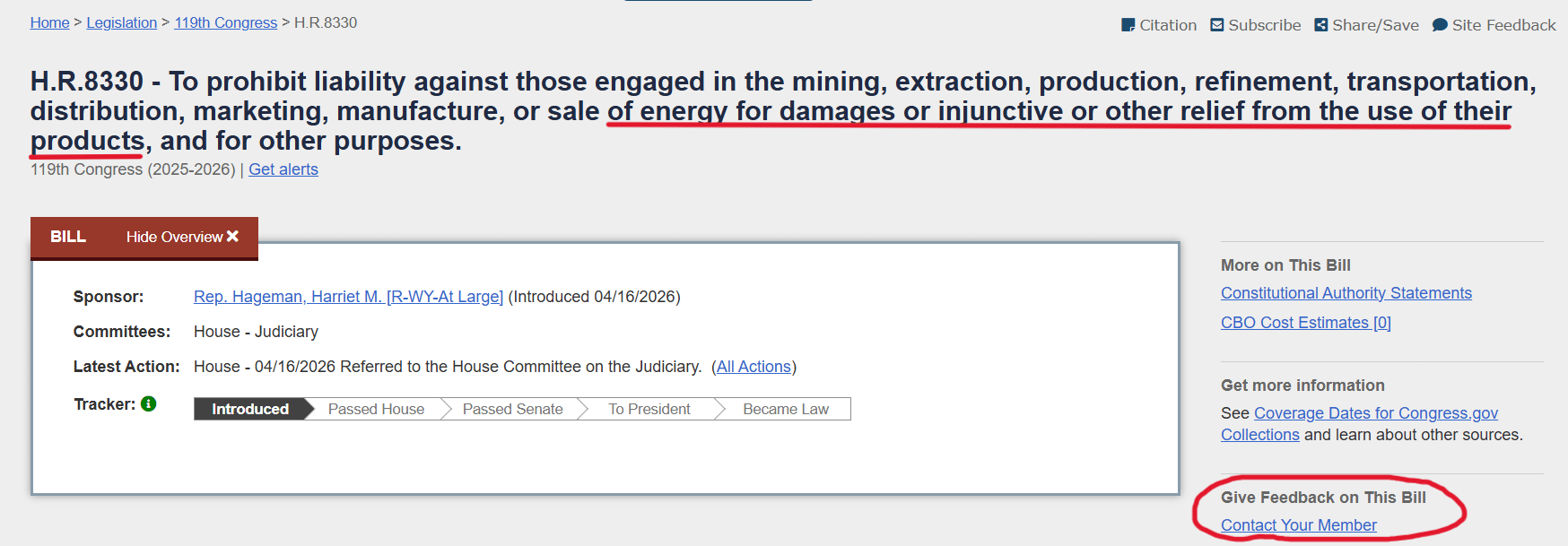
The bill would have the effect of affirmatively barring “retroactive climate liability lawsuits” and nullify existing state climate superfund laws. Hageman’s bill also could be insurance in the event that EPA’s present effort to rescind its (Obama-era) 2009 Endangerment Finding on GHGs succeeds. If that occurs, the Clean Air Act’s federal preemption of state climate tort lawsuits that has been the energy companies’ strongest defense once cases are removed to federal court would be eliminated.
We close with an analogy from a repeated Doomberg refrain since the Russian invasion of Ukraine and NATO’s proxy war in the defense of the latter: “one of the reasons to avoid going to war is because you might lose, and losing wars is hard.” By going to war in state courts, climate litigants have given energy companies some new legal tools and avenues they certainly did not intend.
State climate litigation in blue state courts that results in US taxpayers reimbursing energy companies for climate “damages” from legal activity in support of WWII and similar government directed contracts, you say? That would certainly be an ironic outcome of all this legal maneuvering.
Whether energy companies attempt to deploy this strategy, and how it pans out will take years to determine. Right now, your tax dollars being used to reimburse energy companies for state climate litigation is not something anyone has on their bingo cards. But thanks to the precedents set by Shell at the McColl Superfund site and this month’s Supreme Court decision in Chevron vs. Plaquemines Parish, that possibility is now in play.
“Like” this post if for no other reason than you made it through our longest one yet.
Leave us a comment. We read and reply to them all. Refuels the tank here.
environMENTAL is a reader-supported publication. Subscriptions are free, but please consider becoming a paying subscriber.
Share this post. Helps us grow. We’re grateful for the assist!
Thank you for digging into these very dry legal areas - and joining the dots in the most brilliant (and entertaining) way. The whole "climate reparations" area needs just this kind of ironic outcome.
Whilst no one would condone the WW2 era practices of environmental dumping - I doubt anyone has ever considered the counterfactual of what the world would look like today had the US aviation fuel (and overall war effort) not been realized, and the US had not come to the aid of the UK and Europe, and had"lost" the war in the Pacific? (and yes, I realise that is somewhat a false dichotomy). But the ability to sit in luxuary and opine (litigate) on the past, applying today's moralistic framework, works well when you ignore counterfactuals.
Wow. I am beyond impressed at your ability to peer around corners and imagine how a smart legal team could use the McColl decision and the Supreme Court opinion on Plaquemines to upend the current fashion of cities and states suing oil and gas companies for climate damages. Some of those legal teams might want to hire you.
On a different note, I've often wondered which industries or institutions use the greatest number of acronyms. My top competitors have always been health care, the military, legal/law enforcement, and the oil and gas business. But I think I need to include environmental professionals for the dizzying combination of legal, scientific, and governmental acronyms that make up your language. 😉
Great job. I'll be watching the climate/legal space closely to see if your foresight comes to pass.