

Implausible Deniability
The scary “business as usual” CO2 emissions scenario that was never plausible just got buried, but you wouldn’t know it judging by the scientific cabal's and the legacy media's silence.

“It's tough to make predictions, especially about the future.” - Yogi Berra
In environmental science and economic forecasting, the term “business as usual” is generally understood to mean that current trends and their underlying conditions are expected to continue absent any major interventions or policy changes. In the field of climate science specifically, it turns out “interventions” take many forms, and sometimes the forms that have the least to do with “policy” are the ones the make the most mockery of forecasts.
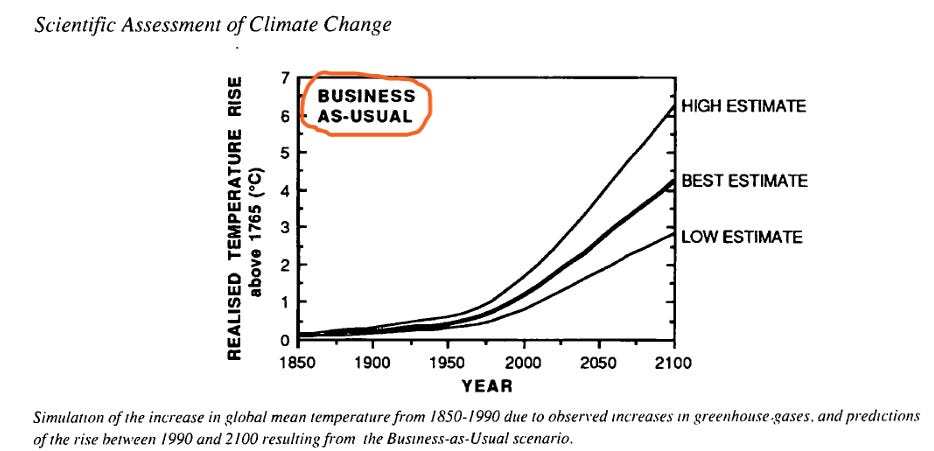
The United Nations Intergovernmental Panel on Climate Change (IPCC) adopted the term “business as usual” (BAU) in their First Assessment Report (AR1) issued in 1990 to its projected trajectory of human emissions of greenhouse gases (GHGs) and in particular CO2. In conjunction, it articulated the downstream effects: radiative forcings that would change the earth’s energy balance leading to atmospheric warming, sea level rise, and a whole host of horrors.
In AR1, the IPCC’s “best estimate” on the BAU trajectory at the time indicated a worrying level of “global warming” of ~4.3 degrees Celsius (~7.65 degrees Fahrenheit), with its “high estimate” a scary > 6 degrees Celsius, or more than 10 degrees Fahrenheit, by the year 2100.
At the time, earth’s population stood at about 5.4 billion people, and global oil consumption was just under 67 million barrels per day (mmbpd).
Today, nearly 8.3 billion earth inhabitants operate around 1.5 billion cars and trucks, almost 100,000 commercial ships, and some 30,000 in-service commercial aircraft, all of which rely on the uninterrupted flow of the refined products from ~104 mmbpd of oil. Most of heavy industry across western civilization still relies on coal and natural gas for process heat.
The CO2 emissions from essential products like steel and cement and the use of natural gas in the production of ammonia-based fertilizers remain extremely difficult to abate. All this combined with global economic growth has added up to even more oil, coal and natural gas being combusted for various human uses today than when AR1 was released ~35 years ago.
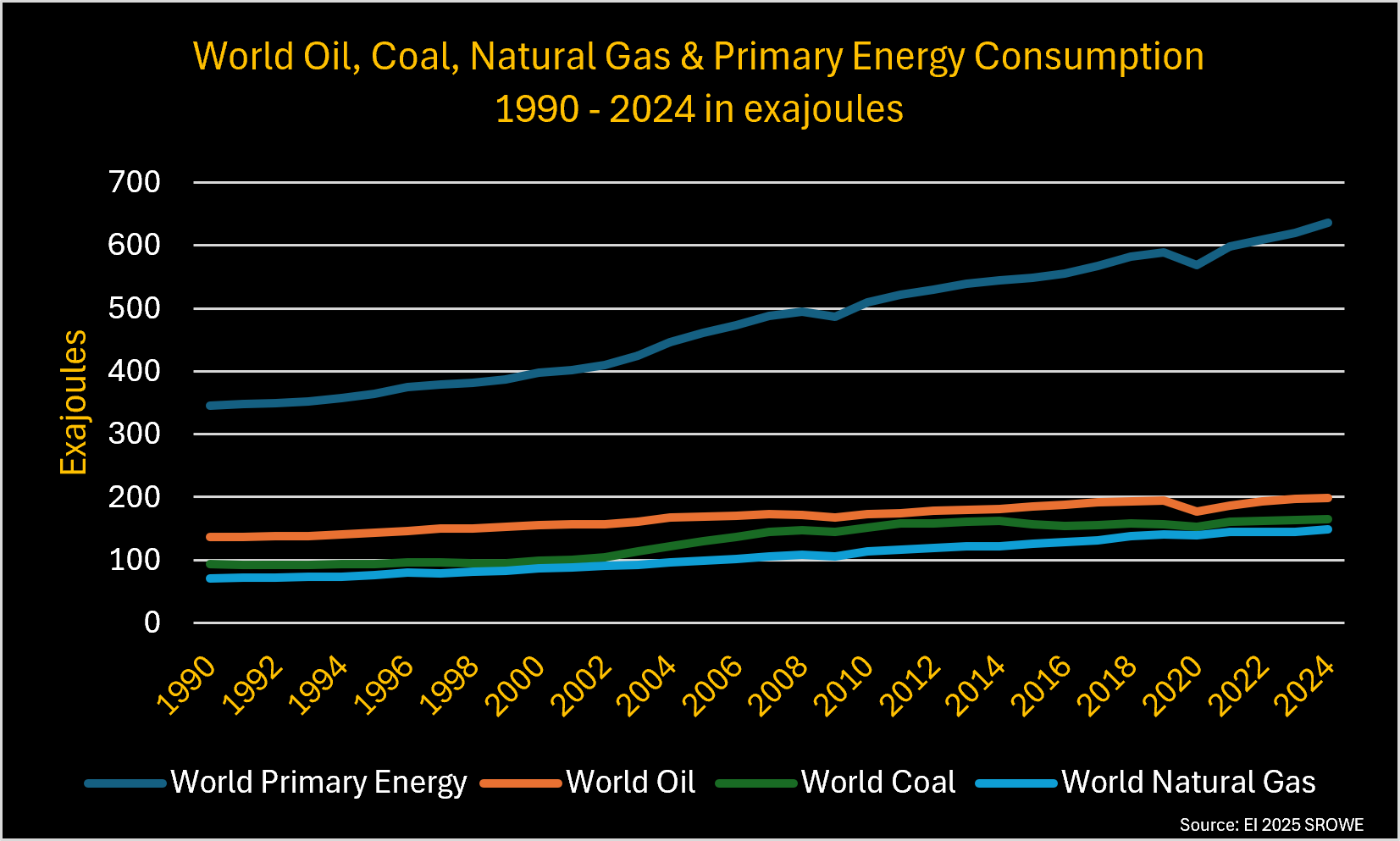
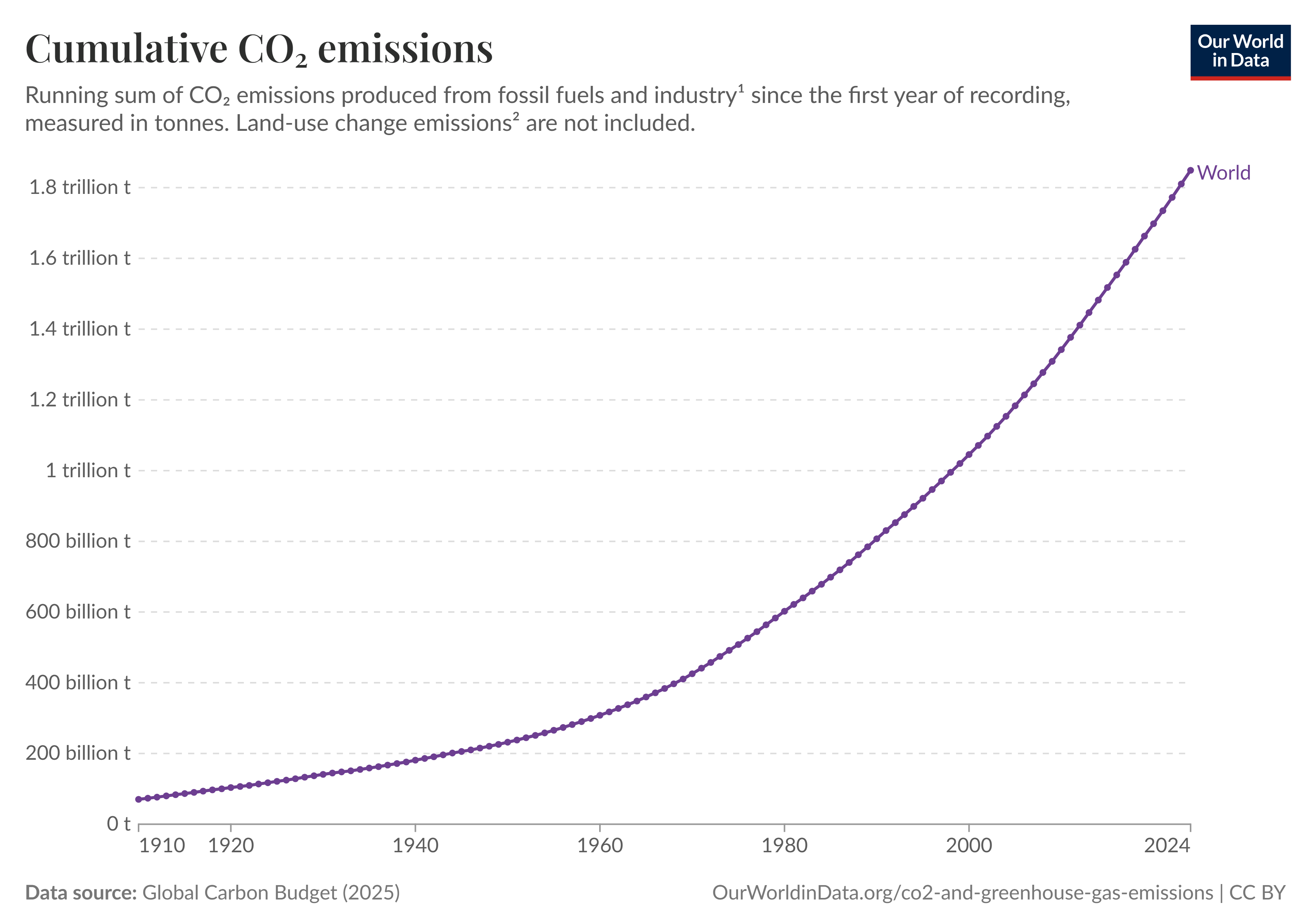
CO2 emissions from transportation and industry have climbed steadily since the time AR1 was published in 1990. Combined with the absence of any global treaties that would commit nations to reduce CO2 and GHG emissions at scale, IPCC’s choice of the term “business as usual” (BAU) may not have seemed unreasonable at the time of AR1’s publication.
Debates over the robustness of the IPCC emissions scenarios and the assumptions contained therein remained mostly the domain of scientists until the early 2000s. We view the 2005 Atlantic Basin hurricane season as the catalyst that changed everything.
In 2005 the U.S. suffered its worst Atlantic basin hurricane season in history, setting records for most named storms (27), most hurricanes (15), most Category 5 storms (4), and highest Accumulated Cyclone Energy. Louisiana took a beating. Few can forget the tragic loss of life, chaos, and destruction in greater New Orleans when Katrina made landfall in late August. But fewer will remember that Rita hammered Cameron Parish in western Louisiana only three weeks after Katrina, destroying every building in Holly Beach. The season was so active it exhausted the entire pre-assigned list of 21 named storms, forcing the National Hurricane Center dig into the Greek alphabet (Hurricane Epsilon was active into early December.)
On the heels of the 2005 hurricane season, former Vice President Al Gore’s “An Inconvenient Truth” was published in book form in May of 2006, with the film’s release following a month later. Gore intimated that the 2005 hurricane season was evidence of an ongoing, intensifying trend in hurricanes (it was not), something of a “new normal” that could be expected in the era of anthropogenic global warming (the term “climate change” would not become mainstream for several more years).
Mother Nature laughed in Gore’s face. The U.S. did not get hit by another major hurricane for ten consecutive years plus ten months, breaking the previous record for consecutive years without a major hurricane landfall (6 years) that had stood for about a century.
But the book and the movie both keyed in on the scary, high emissions “BAU” scenario to paint a very dark picture. In our view, this was the era when the “BAU” terminology combined with legacy media propaganda coverage to spin fear of “climate change” up into a relentless, everything-is-caused-by-climate-change political circus.
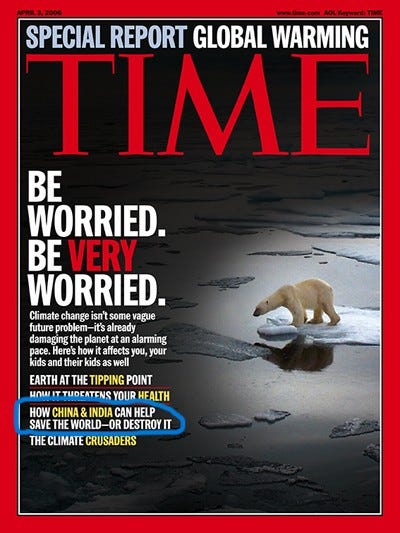
The combination of now six UN IPCC Assessment Reports and the tidal wave of legacy media propaganda portraying end times from the BAU emissions scenarios led to global climate agreements from the 1997 Kyoto Protocol (approved 1997, entered force 2005) to the Paris Agreement (adopted in Paris 2015, entered force 2016). European Union-wide regulations (CO2 “Emissions Trading Scheme” 2005) and a wave of domestic climate legislation, from Germany’s Energiewende to America’s Inflation Reduction Act were also unleashed as a direct result.
On the basis of the apocalyptic future projected by BAU scenario, advanced western nations from America to Europe to Japan embarked on a policy mission in which virtually everything became denominated in GHG and CO2 emissions and climate change. In the process, they spent $5 trillion they didn’t have in an attempt to rebuild their energy systems with an exclusive focus on CO2 emissions using “renewable energy” technologies that never had a chance to replace the services provided by their hydrocarbon and nuclear-based competitors.
The IPCC’s high GHG emissions scenarios would continue to be referred to as the “BAU” scenario across five additional technical frameworks included in five more Assessment Reports (i.e., AR2-6) over a period of more than 30 years.
Projections of future GHG and CO2 emissions are derived from assumptions about changes in population, economic growth, energy/technology, land use (forestry, agriculture), and policies/governance. Future population, energy technology, and economic growth drive the outcomes and predicted downstream climate impacts.
When we first went down the rabbit hole to understand the IPCC scenarios around 2010, we were not qualified to challenge the underlying assumptions relating to future energy use, though the future projections for coal consumption in the high emissions scenarios were a red flag. Global population predictions versus how global fertility rates have trended since were for us an early clue to significant model errors.
National scientific organizations, financial institutions, engineers, policymakers, and others have relied on IPCC Assessment Reports to guide their decision making for more than a quarter of a century. The question of how realistic the high emissions scenarios the IPCC has used to produce its assessment reports has been examined for around half of that time by a small group of dedicated researchers.
Their findings have largely been ignored. All the while, the media continued to magnify the high emissions scenarios as “business as usual,” finding signs of apocalypse in every adverse weather event. And the “overwhelming consensus” of climate scientists did nothing to stop them, some like Michael Mann even gladly acting on advice Al Gore gave in a speech to the 2009 annual meeting of the American Association for the Advancement of Science (AAAS):
“Scientists can no longer in good conscience accept this division between the work you do and the civilization in which you live. Start getting involved in politics. Keep your day jobs but get involved in the debate. We need you.”
Climate scientists’ and the IPCC’s high emissions future scenarios just went up in flames for precisely the reasons the small group of researchers exposing their implausibility previously warned. And those scenarios were ultimately cremated by the very scientific institutions that created them and kept them alive long past their spoil by date.
What just happened that rendered the scary, high emissions future climate projections “implausible?” What does it mean? And how is the news being treated by the same legacy media who used the now demised scenarios to scare the western world into panic? By definition, that which is “unsustainable” cannot go on forever, so let’s put on our lab coats and dig into the biggest news in climate science since Al Gore did not become President.
We begin the story with the announcement that climate science’s high emissions scenarios are going in the garbage bin of scientific history gone astray. Earlier this month, the international committee that produces the GHG emissions scenarios that function as the foundation for most climate research and assessment projections used by climate modelers and the IPCC published the next – 7th – generation of emissions scenarios.
One of the researchers who has been central to the detailed critiques of the high emissions scenarios is Roger Pielke, Jr. Well before Substack was created, Roger and colleagues had deep dived the basis of the scary BAU high emissions scenarios, detailing their increasing departure from objective reality.
At The Honest Broker, he recently described the climate-panic-shattering news:
“The new scenarios come from the Coupled Model Intercomparison Project (CMIP) — a project of the World Climate Research Programme (WCRP), co-sponsored by the World Meteorological Organization, the International Science Council, and UNESCO’s Intergovernmental Oceanographic Commission.
Under CMIP, now in its seventh iteration, sits another little-known committee with responsibility for developing the scenarios necessary for earth system models to project future climate. That committee — called ScenarioMIP — just published the new scenario framework that will underpin the IPCC’s Seventh Assessment Report (AR7) and much of the research that it will draw upon.”
In an admission we had to read twice to make sure we didn’t misread it, the lead author of the paper that introduces the new scenarios makes a stunning admission (emphasis added):
For the 21st century, this range will be smaller than assessed before: on the high-end of the range, the CMIP6 high emission levels (quantified by SSP5-8.5) have become implausible, based on trends in the costs of renewables, the emergence of climate policy and recent emission trends.
A highly abbreviated history of the evolution of the “BAU” scenario and its progeny that sent the advanced world into a panic is necessary. Readers interested in the details will find additional links to resources below.
In summer 2021, Roger Pielke, Jr. and researcher Justin Ritchie penned an article in Issues in Science and Technology highlighting the results of a paper they had recently published arguing how the high emissions climate scenarios had been misused. There they provided a useful but brief explanation about how emissions scenarios are developed and how they feed into the climate models the project future outcomes:
To develop emissions scenarios, scientists begin with assumptions about the future of socioeconomic variables such as economic growth, population growth, and energy consumption, as well as a range of other variables, such as changes in land use (farming, grazing, forestry, and so on) and particulate pollution. They plug these variables into models of society and the economy called integrated assessment models (IAMs) to generate plausible pathways of future emissions—these are the emissions scenarios. These scenarios project the future not only of carbon dioxide emissions, but also of other chemicals that affect the climate, such as methane and nitrous oxide. Emissions scenarios, in turn, are necessary to determine another variable, called radiative forcing, a measure of changes in the net transfer of energy (i.e., heat) in the atmosphere. Radiative forcing pathways (changes in forcing over time) are a key input for the climate models that project the future behavior of climate.
The IPCC has used five different scenario frameworks across its six Assessment Reports (AR1-6). For two - AR3 (2001) and AR4 (2007) - the same “Special Report on Emissions Scenarios” (SRES) scenarios were employed. All five frameworks have included a high emissions scenario widely referred to by legacy media as “business as usual.”
In 2007, the IPCC reacted to calls for improvements to the SRES scenarios by leading the process that delivered the next generation, called the Representative Concentration Pathways. The RCPs were developed using a “parallel approach” to meet the tight timeline for AR5 (2013-2014).
Climate modelers needed scenarios to feed into their models by 2010, so researchers created the RCPs as an interim solution while more thorough “socioeconomic pathways” (SSPs) were being developed. Four RCP scenarios were developed by different research teams and published between 2007-2011.
Here again we return to the Pielke, Jr. and Ritchie 2021 article (emphasis ours):
“In parallel, scenario developers would simultaneously start with this same set of radiative forcing pathways and work backward to develop socioeconomically plausible emissions scenarios that would produce the four RCPs.”
Translation: scenario developers assumed how much GHGs the world would emit, calculated the radiative forcing that would result, and the correlated increase in temperature over the next 90+ years, then force fed the necessary assumptions about population change, economic growth and, most importantly, the energy technologies the world would use 10, 25, 50 and 75 years hence into the emissions trajectories after the fact.
Continuing with the Pielke, Jr. and Ritchie article:
Although the IPCC selected the four radiative forcing pathways to provide a range of projected futures to 2100, it did not consider the plausibility of the socioeconomic assumptions used to generate them…
The IPCC had cut the link between the socioeconomic characteristics underlying the scenarios (population change, economic growth, and so on), the emissions scenarios they provided for climate models, and the climate futures those models would predict. The effect of the separation was to save time while abandoning any commitment to evaluating the scenarios and pathways for plausibility or probability.
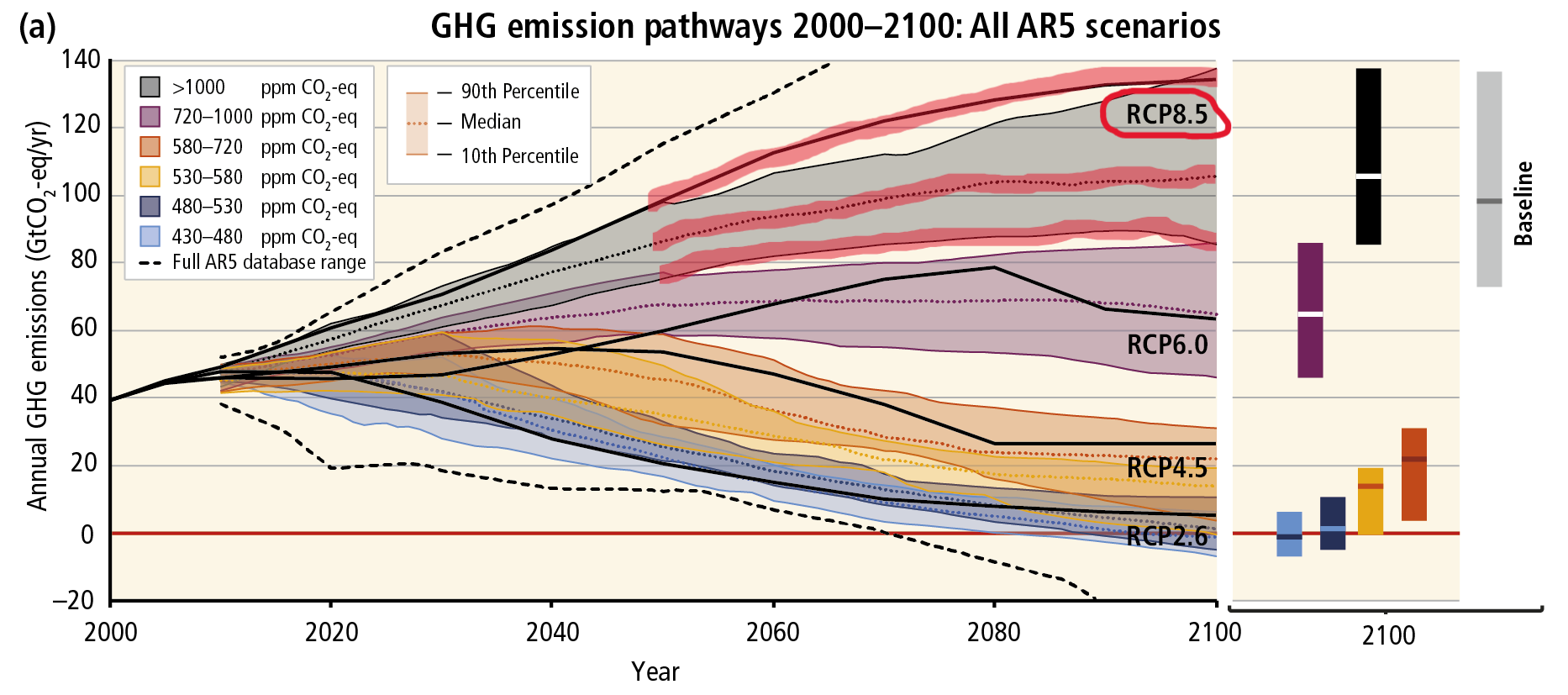
The high emissions scenario – still widely misused as “business as usual” – for the new RCPs was labeled RCP8.5. The numerical value denotes the model output’s expectation of an 8.5 watts/square meter (W/m2) change in radiative forcing compared to earth’s 1750 era pre-industrial baseline.
The graph below displays the anticipated global annual GHG emissions measured in Gigatons CO2 equivalent per year (Gt Co2e/yr.) to the year 2100 for each of the four RCP scenarios. We have highlighted the range of Gts equating to that high level of radiative forcing in RCP8.5 for you (note the values at year 2100: low end ~85 Gt, high end ~135 Gt, central estimate ~105 Gt).
The problem of decoupling the socioeconomic characteristics underlying the scenarios, the emissions scenarios they fed into climate models, and the climate futures those models projected being a rather obvious – and severe - problem, the two finally appeared to catch up when the next emissions framework, the Shared Socioeconomic Pathways (SSP), were developed between 2010 and 2017. In the IPCC’s AR6, published 2021-2023, five SSP’s replaced the four RCP framework.
The graph below compares the annual Gt CO2e emissions trajectories to the year 2100 for the five SSPs. Compare the trajectory and anticipated emissions at the year 2100 for scenario SSP5-8.5 to its progenitor, RCP8.5 (highlighted):
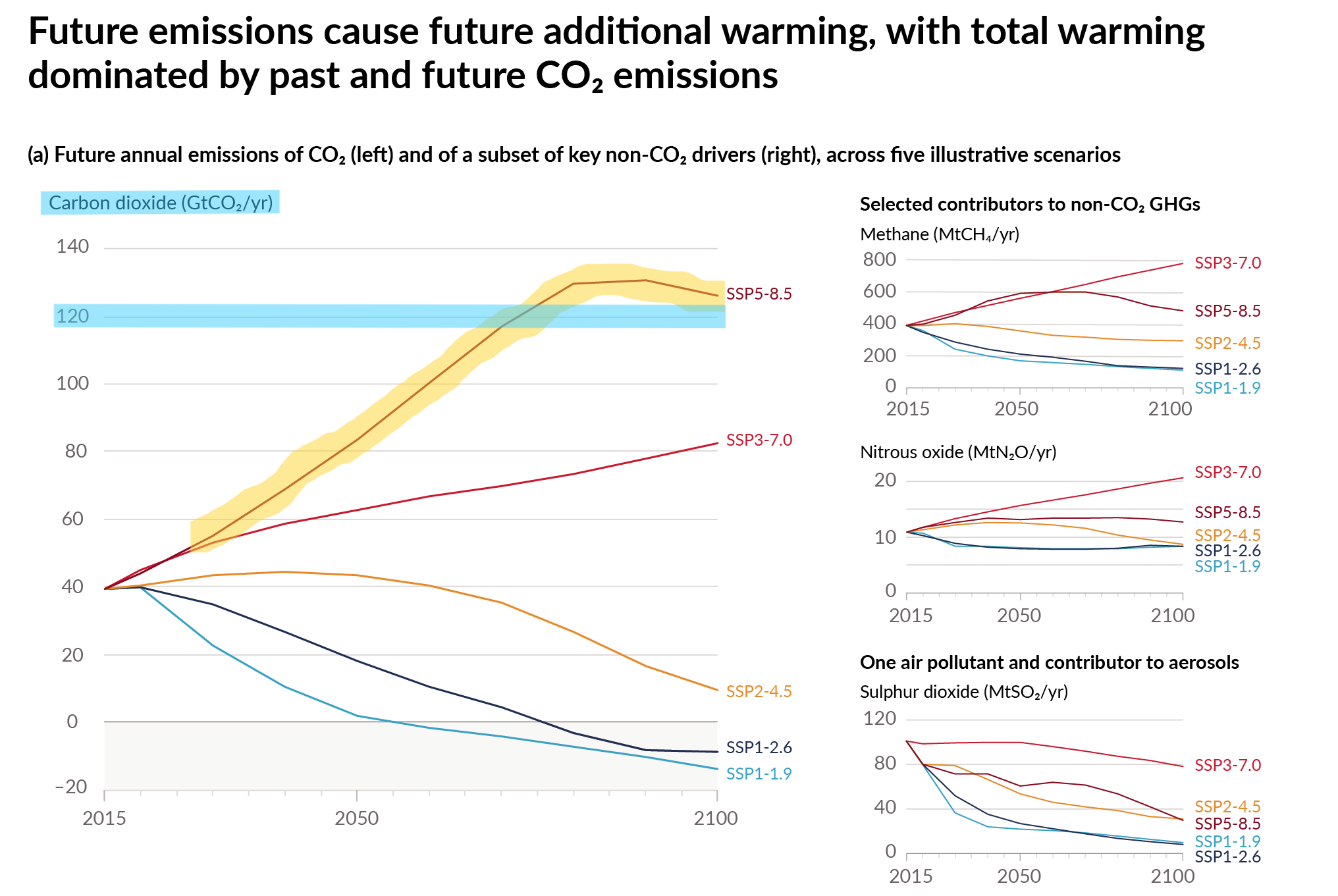
RCP8.5 and its ideological mess of a successor SSP5-8.5 both project annual GHG emissions well in excess of 100 Gt CO2e per year at the year 2100. As others have noted, RCP8.5 required enormous growth in coal consumption, including a six-fold increase in per capita global coal consumption.
Go back and look at the green line documenting global coal consumption since 1990 in our earlier graph of global primary energy consumption. Does an increase of more than five times appear likely based on the trends since RCP8.5 was born in 2007?
Projections of future population were another error that caused the historic high emissions “BAU” scenarios and their successors like RCP8.5 and SSP5-8.5 across six framework series to project unrealistic global GHG emissions and planet-melting correlated temperatures in the year 2100. The table below lists the population projections for the two BAU scenarios prior to the SRES framework, along with RCP8.5 and SSP5-8.5 from the RCP and SSP frameworks, respectively. It turns out all of the population projections were far too high until one (and that one has other “issues”):

If it strikes you as odd that the world’s leading climate modeling scientists and the IPCC calculated nearly the same global annual GHG emissions at the year 2100 in RCP8.5 and its new and “improved” successor SSP5-8.5 with nearly 40% fewer humans on earth, congratulations, you are catching on! That is the effect of the aforementioned six-fold increase in per capita coal consumption in a wealthier 2100 world with far fewer people, a prospect we and others find absurd.
For reference, in 2020 a team at the University of Washington’s Institute for Health Metrics and Evaluation (IHME) projected that the global population would peak around 2064 at just over 9 billion and decline to about 8.8 billion by 2100. The present global fertility rate of ~2.1 birth per fertile woman held constant for 74 years yield an estimated population decline to approximately 7.29 billion by 2100, a net decrease of roughly 960 million from today.
Here we have only highlighted three of the major problems with the high emissions scenarios that scared the world into panic over climate change. But all of these and more were well documented almost ten years ago. For readers wishing to deep dive the extensive problems with RCP8.5 and its successor SSP5-8.5, we highly recommend the following (links embedded in each):
In 2017, researchers Justin Ritchie and Hadi Dowlatabadi found serious errors in estimates of future coal consumption.
In 2021, Ritchie and Roger Pielke, Jr. produced an extensive and detailed critique on the “misuse and abuse of climate pathways and scenarios,” introducing the term “plausibility vacuum” to describe the impact of decoupling the RCPs from relevant socioeconomic assumptions.
Two weeks ago, Roger Pielke, Jr. posted RCP8.5 is Officially Dead with an outstanding summary and timeline at The Honest Broker.
In RCP8.5 is Officially Dead, Pielke, Jr. lays out the details of the new CMIP7 scenarios (that replace the SSPs, which replaced the RCPs) to be used in the upcoming IPCC AR7. Roger was kind enough to allow us to publish the following graph from that post which nicely consolidates and visualizes the implausibility (some would say hilarity) of the previous high emissions scenarios in retrospect:
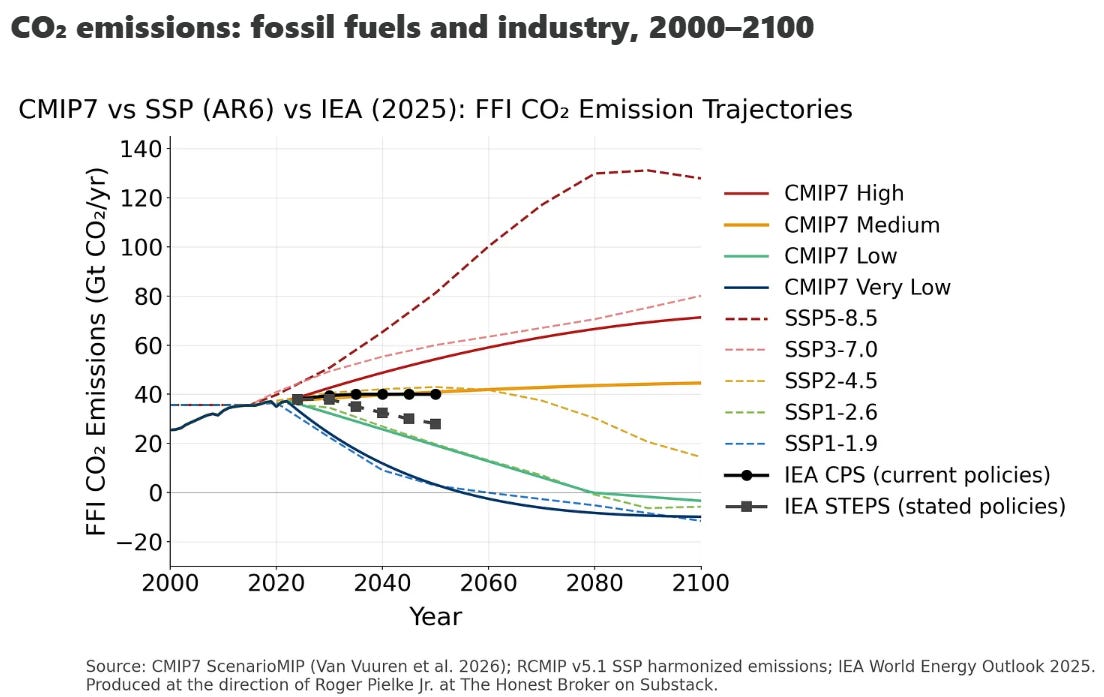
The new CMIP7 “High” scenario replaces the scary RCP8.5 and its successor SSP5-8.5 (The new CMIP7 series also drops SSP3-7.0 as “implausible.”)
You will note that CMIP7 High estimates global annual CO2 emissions at only 78 Gt/year in 2100. That value is a country mile below the 128 to 135 Gt’s projected by its predecessors that triggered a quarter century of worldwide climate panic.
The graph also includes the International Energy Agency’s “Current Policies Scenario” (IEA CPS) and “Stated Policies Scenario” (IEA STEPS) for reference. Think of the CPS as where the planet is headed given the existing combination of the world’s in-force energy/climate policies, existing energy technologies, consumption trends, and demographics. The STEPS alternative represents the emissions trajectory based on the stated intended policies of the world’s sovereign nations.
The astute reader will notice that the IEA CPS line – the IEA’s assessment of where the world is headed – trends along the line of CMIP7 Medium. CMIP7 Medium projects global annual CO2 emissions ~43 Gt/year at 2100. This has two important practical applications:
1. For the next IPCC Assessment Report (AR7, due 2028-2029), the new scenarios include exactly zero projections exceeding 78 Gt CO2e by 2100. Estimates above that value are officially “implausible.”
2. Best estimates of warming vs ~1850 baseline pre-industrial temperatures now fall in the range of 2.5 degrees Celsius. Former “BAU” and high emissions scenario projections of 4.5 C – 6C and greater are also officially deemed “implausible.”
In our view, estimates of future population have been wrong for more than a decade. We noted this in The Population Bombing in our first few months on Substack (March 2023).
There is no way of sugar coating it. The new CMIP7 scenarios destroy twenty years of climate apocalypse narrative.
How is that being reported by legacy media? Other than a few outlets in Europe, basically crickets.
There is much more to be said about the impact of the climate fear porn generated by the now deceased early BAU-denoted high emissions scenarios, RCP8.5, and its successor SSP5-8.5. They influenced the national climate impact assessments of 5 of the G7 nations (and scores of others). Almost 150 global banks used The Network for Greening the Financial System framework that factored RCP8.5 physical risks into bank financial stress tests applied by the U.S. Federal Reserve, the Bank of England, the European Central Bank, and others. These examples, and much more, are covered in greater depth in Roger Pielke, Jr.’s RCP8.5 is Officially Dead and several successive posts at The Honest Broker (and in even deeper detail in his 2021 paper with Justin Ritchie, for paying subscribers).
The “scientific basis” for the climate fear porn that drove the advanced world to expend $5 trillion of money it did not have is “implausible,” relegated to the dust bin of scientific history. Good riddance.
But will the scientific community admit their errors and change course? Tens of thousands of research papers have relied on the now discredited high emissions BAU scenarios, including RCP8.5 and SSP5-8.5, across all six emissions scenario frameworks. Will politically motivated climate scientists continue to push for their relevance as “reference” scenarios?
What about the legacy media? Having published tens of thousands and to possibly over a hundred thousand articles depicting these cremated scenarios as the “business as usual” trajectory the world was on, with every adverse weather event held as evidence of the forthcoming climate Armageddon, and fear their cheapest and easiest sell, will they admit that the truth was not what they chose to present?
Finally, consider the impacts across cornerstones of the argument for aggressive decarbonization like the cost/benefit calculations contained in the Social Cost of Carbon. Or how this should impact catastrophe models used by global commercial insurers.
How might this knowledge impact the capital investment decisions of major utilities in America, Europe, and other advanced nations? How will the world’s major energy companies view the high emissions scenarios melting like the Wicked Witch of the West getting doused with water? And what about future policies that subsidize “renewable energy” and electric vehicles at the expense of the electric grid and the energy security that has become fashionable in the wake of two global energy crises since 2022?
We close by noting that we do not view the errors made by climate modelers and the IPCC through any conspiratorial lens or question their motivations. The lesson that should be learned here is that human socioeconomic decisions and choices about how many children to have, the evolution of energy technologies, and many other factors in the real world are extremely difficult to model, and small divergences between prediction and observed reality compound dramatically over time. And when fed into climate models predicting radiative forcing, correlated warming, and downstream impacts decades into the future, those errors compound into even greater divergences from projections over decades.
The RCP8.5 and SSP5-8.5 scenarios were not implausible “based on trends in the costs of renewables, the emergence of climate policy and recent emission trends.” They were implausible because of errors in assumptions about future energy use, population, and other factors.
Some will argue that China’s “dramatic” growth in “renewable energy” deployment changed the outcome. Here we remind readers that, despite the widely publicized growth in that capacity, in terms of actual consumption coal constitutes over 52% of China’s primary energy consumption and renewables only 11% according to the latest Energy Institute Statistical Review of World Energy. And China’s coal consumption has grown steadily every year since the IPCC issued AR1 in 1990. At that time, coal and natural gas constituted 27% and 20% of world primary energy consumption respectively, a future few saw coming. In the latest Statistical Review, coal accounts for less than 26% and natural gas over 23%. Advanced hydraulic fracturing and the tsunami of natural gas it unleashed in America are a perfect example of the kinds of energy technology changes that frustrate modelers’ attempts to project. No one saw it coming in 1990 when the IPCC issued its first climate change report.
None of this is to say that human emissions of greenhouse gases including CO2 have no impact on earth’s atmosphere. Or that those emissions could not lead to serious problems some day in the future.
But as for the “business as usual,” high emissions scenarios that legacy media, Charlaticians™ like Al Gore, and climate scientists like Michael Mann used to scare the world, their likelihood of occurring was always Slim and None, and Slim took the 4:30 Greyhounds to Abilene years ago. Any attempt to now contend otherwise would be a form of implausible deniability instead of the necessary opportunities for science to self-correct. We advise lower expectations for legacy media and Charlaticians.
“Like” this post or we’ll tattoo RCP8.5 on your head.
Leave us a comment. We read them all and reply to most. Refuels the tank here!
environMENTAL is a reader-supported publication. Subscriptions are free but please consider a paid subscription.
Share this post with someone you know who might find it interesting (or angering!) Helps us grow. We’re grateful for that!
Accountability has been gone for decades when it comes to climate hysteria. Not a single radical claim has come true, yet climate hysteria continues as many sheeple prefer apathy over reality. Trillions and trillions of dollars wasted, for sure, and how many natural resources are being squandered as well? An awful lot 🥲
Some people are too far gone
https://x.com/mazemoore/status/2055376238345076837/video/1?s=46